
Description
Orthopaedic specialist home visits in Mashhad: 24-hour assessment, diagnosis and specialist treatment of musculoskeletal problems at home
The human musculoskeletal system, made up of bones, joints, ligaments, tendons, muscles and peripheral nerves, is the foundation of movement, balance and everyday activity.
Any injury, inflammation, fracture or degeneration in these structures can cause severe pain, disabling loss of movement and a serious fall in quality of life. With acute orthopaedic problems such as fractures, severe back and neck pain, dislocated joints and sports injuries, moving the patient to busy clinics and hospitals in Mashhad is not only very painful and exhausting but can greatly increase the risk of further structural damage, displacement of broken bone fragments and secondary damage to blood vessels and nerves.
In addition, older people with severe knee and hip arthritis, patients with limited mobility, people with cerebral palsy or stroke, and patients who have recently had major orthopaedic surgery (such as joint replacement) face transport problems and long waiting times for their follow-up care.
With its 24-hour orthopaedic home visit service, Tose Salamat clinical care centre in Mashhad allows patients to receive thorough clinical examination, diagnostic tests and specialist treatment plans in the safety and calm of their own home, without having to be moved at all.
Why an orthopaedic home visit in Mashhad matters
Many orthopaedic injuries need prompt specialist assessment, but the patient’s physical condition makes it unsafe to leave home. In these situations a home visit by an orthopaedic specialist is a practical and effective clinical solution:
– Preventing secondary injury: when a fracture is suspected, moving the patient incorrectly can tear nearby blood vessels, damage peripheral nerves and turn a simple fracture into an open or complex one. Having the orthopaedic specialist at the bedside to stabilise the limb, temporarily or definitively, keeps these risks to a minimum.
– Comfort and pain relief: moving a joint that is acutely inflamed, affected by gout or infection, or fractured causes severe pain. Examining at home allows pain to be controlled with injected medicines and temporary splints before any movement.
– Less stress for the family: arranging an ambulance or wheelchair, carrying the patient down buildings without a lift and waiting in emergency departments put a heavy emotional and financial burden on families.
– Assessing the home environment: at the patient’s home, the orthopaedic specialist can assess hazards such as stairs, slippery rugs, bed height and the bathroom, and advise on changes to prevent further falls (especially in older people with osteoporosis).
How common orthopaedic problems develop in middle-aged and older people
To understand why orthopaedic treatment matters, it helps to look at how musculoskeletal problems develop:
– Osteoporosis: this “silent” disease reduces bone density and damages the internal structure of bone. In older age even a light knock or a simple fall at home can cause serious fractures, especially of the hip (femoral neck), wrist and lumbar vertebrae. A hip fracture in an older person is an orthopaedic emergency that needs prompt assessment and surgery, because the long bed rest that follows greatly increases the risk of pulmonary embolism, bedsores and chest infections.
– Osteoarthritis: a degenerative joint disease in which the joint cartilage gradually wears away, the bones rub together and extra bone growths (osteophytes) form. Knee and hip osteoarthritis are the most common causes of chronic pain and limited mobility in middle-aged and older people in Mashhad, and in advanced stages may need joint replacement surgery (arthroplasty).
– Disc disease and herniated discs in the back and neck: a bulging or herniated intervertebral disc can press directly on nerve roots (such as the sciatic nerve). This causes pain spreading into the legs or arms, numbness, tingling and, in severe cases, muscle weakness and foot drop, which calls for careful neuromuscular assessment by an orthopaedic specialist at home.
What the orthopaedic specialist does at home
The orthopaedic specialist sent by Tose Salamat centre in Mashhad carries out a wide range of clinical and treatment procedures at the patient’s home:
– Systematic physical examination: checking joint range of motion, specific tests for the menisci and ligaments, tendon reflexes, and careful examination of the blood supply and nerves of the limbs.
– Casting and splinting: for undisplaced fractures or hairline cracks, the orthopaedic specialist applies a cast (using light, modern fibreglass) or a suitable splint at the patient’s home.
– Temporary skin or skeletal traction: to relieve pain and hold the bone in thigh or pelvic fractures before surgery.
– Intra-articular injections: injecting corticosteroids, hyaluronic acid (“knee gel”) or PRP into joints such as the knee and shoulder to reduce severe arthritis pain and temporarily improve joint function.
– Reducing dislocated joints: in suitable cases, and under local anaesthesia or sedation, dislocated shoulders or fingers without vascular injury can be put back in place at home.
– Managing and dressing orthopaedic surgical wounds: removing stitches and checking for infection after joint replacement or pin fixation.
– Regular follow-up after surgery: assessing bone healing and arranging physiotherapy and occupational therapy at home.
Specialist joint injections: methods and uses at home
Local and joint injections are among the most requested services at orthopaedic home visits. They help patients who cannot move because of severe joint pain to get through the acute inflammatory phase:
– Corticosteroid injections: very strong anti-inflammatory medicines used for acute bursitis, tendinitis or sudden flare-ups of arthritis in the knee, shoulder or wrist. They act quickly but should not be repeated too often in a year, to avoid damaging the cartilage.
– Hyaluronic acid injections (lubricating supplements): this gel-like fluid acts as a lubricant and shock absorber in the knee. In mild to moderate osteoarthritis it can reduce pain for several months and improve range of motion.
– PRP (platelet-rich plasma) injections: a sample of the patient’s blood is taken and centrifuged, and the plasma rich in growth factors is injected into the injured tendon or joint to speed up natural tissue repair. This can be done at the patient’s home under fully sterile conditions.
Managing fractures and cast care at home
Fractures happen for many reasons, including falls, accidents and direct blows. After reviewing portable X-ray images (arranged by the centre), the orthopaedic specialist decides on the treatment at home:
– Stable, undisplaced fractures: these are usually treated with a cast or splint. The specialist immobilises the limb with modern fibreglass casts, which are lighter, more resistant to moisture and better ventilated.
– Teaching cast care to the patient and family:
1. Keep the limb in the cast raised above the level of the heart for the first 48 hours to reduce swelling.
2. Keep checking the colour, temperature, feeling and movement of the fingers or toes. If they become cold, blue or numb, or there is sudden severe pain, tell the doctor immediately, as this may be a sign of compartment syndrome (dangerously high pressure inside the tissues).
3. Never push any object under the cast to scratch the skin, to avoid wounds and infection.
4. Keep the cast dry and protect it from knocks and direct pressure.
Orthopaedic emergencies that need urgent treatment
In some situations a delay in orthopaedic treatment can lead to serious, permanent complications. Families should know these signs and, if they see them, arrange an urgent orthopaedic home visit or emergency transfer immediately:
– Open fractures: where the skin over the broken bone is torn and the bone is exposed. There is a high risk of bone infection (osteomyelitis), and this is a surgical emergency.
– Vascular or nerve injury with a fracture or dislocation: signs such as a cold, pale limb, no pulse at the end of the limb, complete numbness or inability to move the fingers or toes.
– Compartment syndrome: very severe, increasing pain that is not controlled by ordinary painkillers and gets much worse when the fingers or toes are moved passively, with the skin of the limb becoming hard and tight.
– Acute joint infection (septic arthritis): a joint that suddenly becomes hot, red, swollen and very painful, with fever and chills. It needs urgent drainage of the joint and strong antibiotic treatment to prevent destruction of the cartilage.
– Cauda equina syndrome: caused by severe pressure on the nerve roots at the lower end of the spinal cord, usually from a large disc herniation. Signs include numbness in the saddle area (perineum), loss of bladder or bowel control and progressive weakness in both legs; it needs emergency surgery, ideally within 24 hours.
Additional diagnostic services at home in Mashhad
A complete orthopaedic home visit often needs additional diagnostic services, all of which Tose Salamat centre arranges and provides at the patient’s home:
– Portable digital X-ray at home: a radiography technician brings portable digital equipment to the bedside and X-rays the limb suspected of fracture or dislocation. The images can be viewed immediately on screen and sent to the orthopaedic specialist.
– Musculoskeletal ultrasound at home: to check for torn tendons, joint cysts, fluid in the joints and the condition of the ligaments.
– Blood sampling at home: to check inflammatory markers (ESR, CRP), uric acid (to diagnose gout), calcium, phosphorus and vitamin D, and to look for possible systemic or joint infection.
Care at home after orthopaedic surgery: preventing thrombosis and embolism
Patients who have had major surgery such as total knee replacement (TKR), total hip replacement (THR) or fixation of major fractures need very careful care at home after discharge:
– Preventing deep vein thrombosis (DVT) and pulmonary embolism: immobility after orthopaedic surgery is the biggest risk factor for blood clots in the legs. At home visits the orthopaedic specialist monitors anticoagulant medicines (such as enoxaparin injections or rivaroxaban tablets) and teaches the use of compression stockings and ankle-pump exercises.
– Managing pain after surgery: adjusting opioid and non-opioid painkillers so that pain is controlled and the patient can do their rehabilitation exercises.
– Caring for the stitches and dressing: checking for discharge, redness or opening of the wound edges. Stitches are usually removed at home by the centre’s nursing staff 10 to 14 days after surgery.
Coordinating rehabilitation after an orthopaedic home visit
Treating orthopaedic problems is not only about medicines, casts or surgery; physical rehabilitation plays a key role in returning the patient to their previous level of function. After examining the patient at home, the orthopaedic specialist writes rehabilitation protocols for:
– Physiotherapy at home: portable electrotherapy, ultrasound, high-power laser and specialist exercise therapy to reduce pain, increase joint range of motion and strengthen weakened muscles.
– Occupational therapy at home: retraining activities of daily living (ADLs), prescribing and teaching the use of aids (walker, cane, wheelchair), adapting the home to prevent falls and improving the patient’s movement patterns.
How the family can prepare before the orthopaedic specialist arrives
To make the visit more effective and let the doctor focus on examining the patient, families should:
– Prepare the patient’s complete medical file, including all previous X-rays, CT scans, MRI scans, prescriptions and hospital discharge summaries.
– Dress the patient in comfortable, loose clothing so the shoulders, hips, knees and ankles can be examined easily without painful movement.
– Make sure the room is well lit for careful examination of the skin, swelling, colour changes or wounds.
– Write down a complete list of all the patient’s medicines (including heart, blood pressure and diabetes medicines and supplements) so possible interactions with painkillers or new orthopaedic medicines can be checked.
Frequently asked questions about orthopaedic home visits in Mashhad
Can X-rays be taken at the same time as the orthopaedic visit?
Yes. If needed and arranged in advance with the centre, the portable radiography team arrives at the same time as, or shortly before, the orthopaedic specialist and takes the X-rays so the doctor has the images during the visit.
How can I tell whether limb pain is from a fracture or a simple bruise?
Signs such as an obvious change in the shape of the limb, complete inability to bear weight or move it, sudden severe swelling and bruising, and very severe pain at the slightest touch make a fracture much more likely and need orthopaedic assessment.
Can a fibreglass cast be applied at home?
Yes. The orthopaedic specialist brings all the equipment needed for light fibreglass casts, splints and specialist bandaging and applies them at home following proper clinical practice.
What happens if emergency surgery is needed after the home visit?
If the specialist finds that surgery is needed, they issue an urgent admission letter, and Tose Salamat centre arranges an ambulance and direct admission of the patient to a well-equipped hospital in Mashhad.
Is a knee gel injection at home safe?
Yes. The injection is given by the orthopaedic specialist under fully sterile (aseptic) conditions to prevent any bacteria entering the joint.
What is the difference between a splint and a full cast, and which is preferred at home?
A splint (a half cast) holds the limb from one or two sides and allows early swelling to settle without pressing on the blood vessels. A full cast surrounds the whole limb and is used for longer-term immobilisation once the swelling has gone down. The choice depends entirely on the type of injury and the orthopaedic specialist’s judgement.
Are orthopaedic home services available for children?
Yes. The orthopaedic specialist can assess sports injuries, childhood fractures, common dislocations (such as “pulled elbow” in young children) and structural problems of children’s feet and legs at home.
How is the cost of an orthopaedic home visit in Mashhad calculated?
The basic fee is based on the approved tariffs for home medical services, and extras such as casting, splinting, joint injections, imaging and laboratory tests are added to it. For an exact quote, please call the centre.
Is the orthopaedic home visit service available around the clock?
Yes. Tose Salamat centre’s coordination team and orthopaedic specialists are available 24 hours a day, including holidays, to respond to orthopaedic emergencies and send a doctor to your home.
Tose Salamat clinical care centre, Mashhad
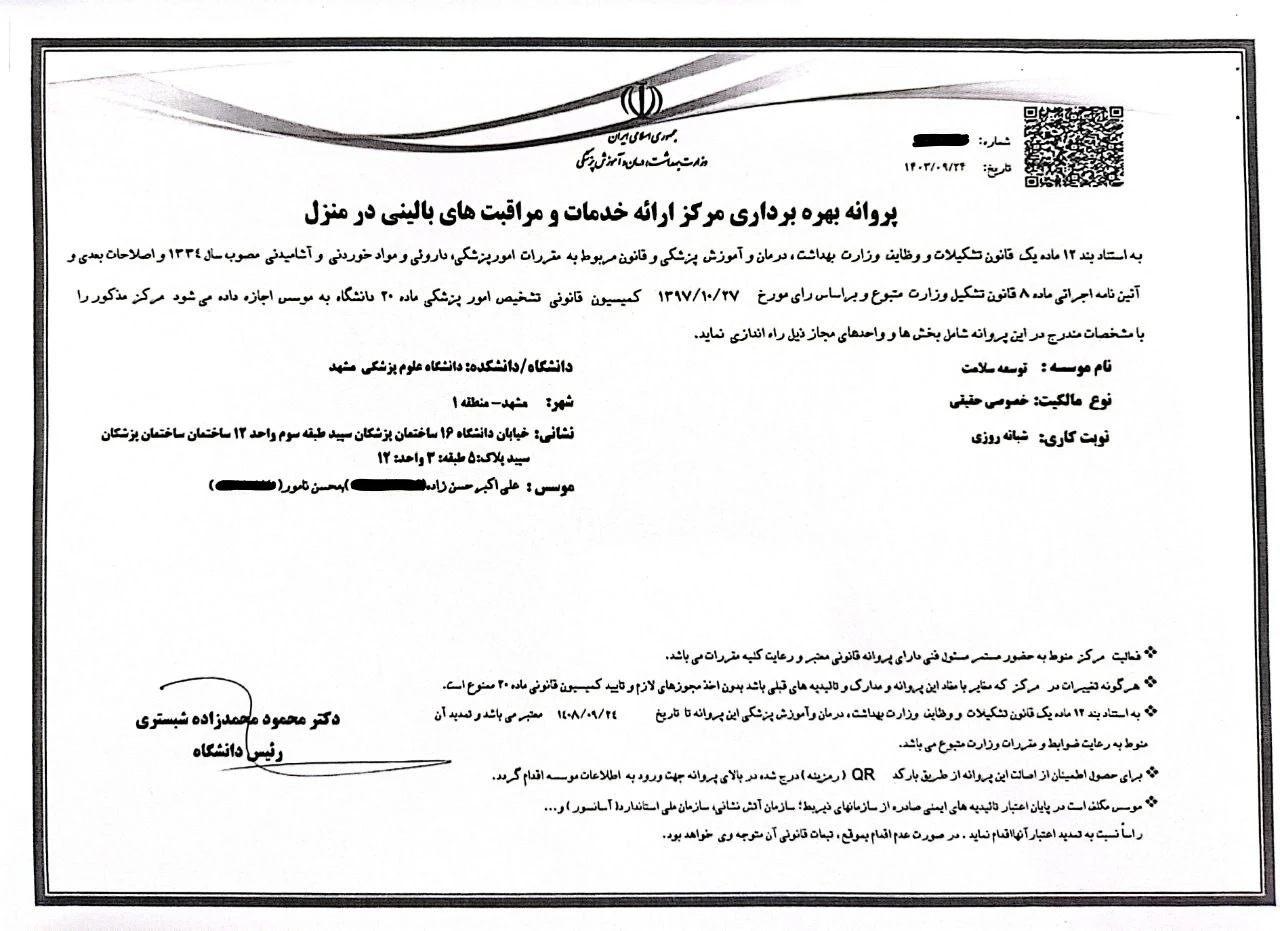
Tose Salamat centre in Mashhad holds official licences from the Ministry of Health and Medical Education and is recognised as one of the leading home healthcare providers in Mashhad. Working with orthopaedic specialists and subspecialists, orthopaedic surgeons, experienced nurses and rehabilitation teams (physiotherapy and occupational therapy), we offer a complete chain of musculoskeletal care in your home.
Using portable digital diagnostic equipment and high-quality consumables ensures that the care provided at home meets hospital standards. Our aim is to relieve pain quickly, treat injuries safely within the family setting and restore patients’ mobility while preserving their dignity and peace of mind.
To arrange an orthopaedic specialist home visit in Mashhad, portable X-ray, casting, joint injections or stitch removal, day or night, call +98 930 900 9159.