
Description
The urologist at home in Mashhad and the value of clinical urology care at home
Urology is a specialist and vital branch of clinical medicine responsible for assessing, diagnosing, treating and managing disorders of the urinary system in women and men, and diseases of the male reproductive system.
It covers the kidneys, ureters, bladder, urethra and adrenal glands in both sexes, and the prostate, testes, epididymis, seminal vesicles and penis in men.
Urological disorders include a wide range of common conditions, such as recurrent urinary tract infections, kidney and bladder stones, benign prostate enlargement, cancers of the urinary and genital tract, urinary incontinence, bladder dysfunction (such as neurogenic bladder) and sexual dysfunction.
Many of these conditions appear especially in old age, after major surgery, in patients with neurological disorders (such as stroke, MS, Parkinson’s disease and spinal cord injury) and in patients receiving palliative care, and they need continuous specialist management.
A urologist home visit service in Mashhad is a direct and effective answer for patients who cannot attend busy surgeries and clinics because of acute illness, severe frailty, limited mobility, old age or distance from medical centres.
Taking an older patient with dementia, or a paralysed patient with a blocked urinary catheter, to hospital is not only exhausting and painful for the patient and family but also greatly increases the risk of drug-resistant hospital infections.
A urologist at home makes it possible to carry out a careful clinical assessment in the calm of the home, a systematic physical examination, outpatient diagnostic and treatment procedures (such as catheter changes, bladder washouts, nephrostomy tube changes and urethral dilation) and preventive care planning, without physical or emotional strain for the patient.
Clinical anatomy and physiology of the urinary and genital system
To understand urology care at home, it helps to know how this system is built and how it works. The kidneys, the body’s main filters, filter around 180 litres of blood plasma a day and remove excess water, electrolytes and nitrogen-containing waste (such as urea and creatinine) as urine.
Urine is carried to the bladder through the ureters, narrow muscular tubes, by wave-like contractions (peristalsis). The bladder is a hollow muscular organ (the detrusor muscle) that acts as a temporary reservoir. Passing urine (micturition) is a complex neuromuscular process that requires coordination between the autonomic nervous system (sympathetic and parasympathetic), the voluntary nervous system and the internal and external urethral sphincters.
In many neurological diseases that need a urologist at home, this coordination is disrupted. For example, in spinal cord injury or MS, detrusor–sphincter dyssynergia can occur: the bladder muscle contracts but the urinary sphincter does not relax at the same time. This causes high pressure in the bladder, backflow of urine to the kidneys (vesicoureteric reflux), hydronephrosis and eventually damage to kidney tissue and chronic kidney failure.
The prostate, which lies below the bladder and surrounds the male urethra, enlarges with age (hyperplasia). Its growth presses on the urethra and stops the bladder emptying fully, leading to residual urine, bladder stones and repeated urinary infections. With a good understanding of these mechanisms, the urologist at home plans diagnosis and treatment to protect the kidneys upstream.
Comprehensive urological assessment at home: history and examination
A standard urologist home visit begins with a multi-stage clinical assessment. The first part is a detailed medical history. The doctor asks about lower urinary tract symptoms (LUTS), which fall into storage symptoms, such as frequency, urgency, getting up at night to pass urine (nocturia) and burning (dysuria), and voiding symptoms, such as hesitancy, a weak or interrupted stream, prolonged voiding and a feeling of incomplete emptying.
Past history of systemic diseases is also recorded carefully, including diabetes (which affects the nerves of the bladder), high blood pressure, heart disease, stroke, previous pelvic and abdominal surgery, and a full list of medicines (especially anticholinergics, diuretics and painkillers).
The physical examination at home is carried out with full respect for the patient’s privacy. It includes feeling and percussing the abdomen for a distended bladder (urinary retention) and checking for tenderness at the costovertebral angle (CVA tenderness) for kidney inflammation or infection (pyelonephritis). In male patients, the external genitals are examined for phimosis, paraphimosis, hydrocele, varicocele or skin lesions.
An important part of the examination in older men is the digital rectal examination (DRE) to assess the size, consistency and symmetry of the prostate and any hard nodules, which helps distinguish benign prostate enlargement (BPH) from prostate cancer. If needed, reflexes related to the sacral spinal segments (such as the bulbocavernosus reflex) are tested to check the nerve pathways involved in passing urine.
Specialist management of urinary catheters at home
Urinary catheterisation is one of the most common procedures in home urology. Catheters are used for acute or chronic urinary retention, accurate monitoring of urine output in very ill patients, recovery after certain operations, control of severe incontinence that is causing pressure sores, and in disabled patients.
Changing and caring for catheters requires strict aseptic technique to prevent bacteria entering the urethra and causing catheter-associated urinary tract infection (CAUTI).
The urologist at home prescribes and manages different types of catheter according to the patient’s needs:
Foley catheter and its care
The Foley catheter is the most common type: a two-way or three-way catheter with a balloon that sits in the bladder for continuous drainage. The urologist chooses the right size (on the French scale) and material (latex for short-term use, or 100% silicone for long-term use) and changes it safely.
Inflating the balloon with the recommended amount of sterile water and making sure it sits correctly at the bladder outlet are very important. Where there is heavy bladder bleeding (haematuria), three-way catheters are used for continuous bladder irrigation to prevent clots forming and blocking the catheter.
Clean intermittent catheterisation (CIC)
In patients with neurogenic bladder, spinal cord injury or a weak detrusor muscle, CIC is preferred to a permanent catheter, which carries a high risk of infection. Single-use catheters are passed into the bladder at set intervals (for example every 4 to 6 hours), drain the urine and are removed.
The urologist at home teaches this technique to the patient or carers, including hand hygiene, gentle insertion, timing according to fluid intake and the warning signs of infection.
Suprapubic catheter
A suprapubic catheter passes directly into the bladder through a small opening in the skin of the abdomen just above the pubic bone. It is used when the urethra is completely blocked (for example by a severe stricture or a very large prostate) or when long-term use of a Foley catheter has damaged the urethra or caused repeated infections. The urologist changes these catheters at home following minor-surgery principles, checks the exit site for infection or leakage and applies a suitable dressing.
Nephrostomy tube
When the ureter is blocked by pelvic tumours, large stones or fibrosis and an internal stent (double-J) cannot be placed, urine is drained directly from the kidney to the outside through a nephrostomy tube passed through the skin of the back into the kidney pelvis. Caring for, flushing with normal saline to prevent sediment and blockage, and periodically changing these tubes are very delicate tasks that should only be done by a urologist, to avoid dislodging the tube and damaging the kidney.
Urinary tract infections (UTIs) in patients cared for at home
UTIs are among the most common causes of medical emergencies in patients cared for at home, especially older people and those with catheters. Common organisms such as E. coli, Klebsiella, Proteus and Pseudomonas can easily travel up the urethra and infect the bladder (cystitis) or kidneys (pyelonephritis).
Classic symptoms include burning, frequency, urgency, pain above the pubic bone and foul-smelling or bloody urine. In older people or those with dementia, however, these may be completely absent, and infection may show up as a sudden change in mental state (delirium), agitation, loss of appetite, repeated falls or swings in blood sugar.
The urologist at home starts treatment after careful clinical assessment and urine tests (urinalysis and culture with antibiotic sensitivity).
In patients with a catheter, the old catheter should be changed before starting antibiotics, because bacteria live in a biofilm on the catheter wall that does not respond to medicines. Choosing the right antibiotic based on local resistance patterns and culture results, preventive treatment for patients with recurrent infections, and teaching prevention, such as good hydration, correct perineal hygiene and, where appropriate, cranberry or probiotic supplements, are also part of the urologist’s role.
In more severe cases, when the patient has high fever, chills and low blood pressure and urosepsis is suspected, the urologist promptly starts intravenous treatment at home or arranges hospital transfer.
Benign prostate enlargement (BPH) and its management at home
Benign prostatic hyperplasia (BPH) is the most common urological condition in older men. With age, epithelial and stromal cells multiply in the transition zone of the prostate, squeezing the prostatic urethra and obstructing the bladder outlet.
Patients usually complain of a weak stream, dribbling at the end and needing to strain. Without proper treatment, BPH can cause serious complications such as acute urinary retention (a painful emergency), kidney failure from hydronephrosis on both sides, bladder stones and recurrent haematuria.
After confirming the diagnosis with a DRE, a PSA (prostate-specific antigen) test and, where possible, portable ultrasound of the kidneys and urinary tract, the urologist at home starts the most suitable treatment:
Alpha-1 blockers
Medicines such as tamsulosin, terazosin and alfuzosin relax the smooth muscle of the bladder neck and prostate, reduce resistance to urine flow and quickly improve symptoms. The urologist adjusts the dose carefully, especially because of the side effect of a drop in blood pressure on standing (orthostatic hypotension), which in older people can cause dizziness and falls.
5-alpha-reductase inhibitors (5-ARIs)
Medicines such as finasteride and dutasteride block the conversion of testosterone to dihydrotestosterone (DHT) and gradually shrink the prostate (by about 20–25%) over six months of treatment, reducing the long-term risk of retention and surgery. The urologist monitors their effect on PSA levels and takes it into account when interpreting tests.
Combination treatment and managing acute retention
When symptoms are severe or the prostate is large, combination treatment (such as tamsulosin with finasteride) is prescribed. If the patient develops acute urinary retention at home, the urologist catheterises them urgently at the bedside to drain the bladder. If a standard catheter cannot be passed because the prostate is very large, the doctor uses a curved-tip (Coudé) catheter or, where appropriate, places an emergency suprapubic catheter.
Neurogenic bladder and loss of bladder control in paralysed and neurological patients
Neurogenic bladder means any disturbance in storing or emptying urine caused by disease or injury of the nervous system. Patients with stroke, Parkinson’s disease, multiple sclerosis (MS), Alzheimer’s dementia, severe lumbar disc herniation, spinal stenosis, advanced diabetic neuropathy and brain or spinal cord injury are at high risk.
The bladder may behave in two main ways: a spastic (overactive) bladder, with involuntary contractions of the detrusor causing urgency and urge incontinence, or a flaccid (hypotonic/atonic) bladder, which does not contract and fills painlessly to very large volumes, causing overflow incontinence.
The urologist’s approach at home is tailored to each patient’s condition. For a spastic bladder, anticholinergic medicines (such as oxybutynin or solifenacin) or beta-3 agonists (such as mirabegron) are used to relax the bladder and increase capacity.
Monitoring the side effects of anticholinergics (dry mouth, constipation, blurred vision and worsening confusion in older people) is a priority. For a flaccid bladder, the focus is regular emptying, preferably by teaching and carrying out clean intermittent catheterisation (CIC) rather than abdominal pressure techniques (the Credé manoeuvre), to prevent high pressure reaching the kidneys and recurrent pyelonephritis.
Managing urinary stones and renal colic at home
Kidney, ureter and bladder stones are among the most common causes of sudden, severe pain. Renal colic, caused by a stone stuck in the urinary tract and strong contractions of the ureter trying to push it through, is described as one of the most severe pains known in medicine.
It is often accompanied by nausea, vomiting, blood in the urine, burning and frequency. Older or immobile patients (such as paralysed or bedbound patients) are prone to urinary stones (especially calcium phosphate and struvite stones) because of urine stasis and repeated infections.
When faced with a patient with renal colic, the urologist at home will:
Control acute pain
Pain relief comes first. The doctor controls severe ureteric spasm with injected non-steroidal anti-inflammatory drugs (such as ketorolac) or strong opioid painkillers. Antispasmodics (such as hyoscine) can also help.
Medical expulsive therapy (MET)
For lower ureteric stones of suitable size (under 10 mm), the urologist prescribes medicines that relax the ureter, such as tamsulosin, to help the stone pass without invasive procedures.
Order further tests
A urine test is requested to check for crystals, red blood cells and infection, and portable ultrasound at home is arranged to assess the size and position of the stone and any hydronephrosis (swelling of the kidney). If the stone completely blocks a kidney and there is infection with high fever, the urologist urgently arranges an invasive procedure (such as stent placement or hospital transfer for surgery) to prevent kidney damage.
Diagnosis, screening and follow-up of urological cancers at home
Cancers of the urinary and genital tract, including prostate, bladder, kidney and testicular cancer, make up an important part of urological disease. In older or frail patients, regular screening and follow-up of cancer treatment at home are especially important.
Prostate cancer is the second most common cancer in men. The urologist at home identifies suspicious cases with annual PSA tests and prostate examination (DRE). For patients with advanced prostate cancer on hormone treatment (such as LHRH analogue injections, for example triptorelin or leuprorelin), these specialist intramuscular injections are given regularly at home by the care team.
In bladder cancer, whose common sign is painless haematuria (visible blood in the urine without pain), the urologist at home begins the initial assessment. For patients after surgery who need treatment inside the bladder (intravesical therapy) with medicines such as BCG or mitomycin, the urologist can, where appropriate and safe, instil the medicine directly into the bladder through a sterile catheter and guide care after the treatment.
Continuous monitoring of kidney function in patients with kidney cancer or pelvic tumours that compress the urinary tract is also a key part of supportive urology at home.
Urology procedures that can be done at home in Mashhad
Many urological diagnostic and treatment procedures that once required admission or a well-equipped clinic can now be done safely and easily at home thanks to portable equipment, minimising cost, the risks of travel and stress for the patient.
Some of the most important home urology procedures are:
Portable ultrasound of the urinary system
With small, advanced ultrasound devices, the urologist can examine the kidneys at home for stones, cysts, tumours and hydronephrosis. The volume of urine left in the bladder after voiding (post-void residual, PVR) can also be measured with bladder ultrasound to diagnose retention, a non-invasive and very accurate tool.
Changing specialist drainage tubes at home
Nephrostomy tubes, suprapubic catheters and silicone Foley catheters are changed regularly at home under fully sterile clinical conditions. The doctor also checks the dressings around the tubes and teaches skin care around the openings.
Urethral dilation
In patients with mild urethral strictures who have retention or a very weak stream, the urologist can gradually and safely widen the urethra at home using special dilators (bougies) and anaesthetic lubricating gel. This avoids the need for general anaesthesia in many high-risk older patients.
Bladder washouts and sterile sampling
In patients with heavy sediment, blood clots or mucus whose catheters block repeatedly, the bladder is washed out with sterile solutions. For accurate urine cultures without contamination, samples are taken directly from the catheter port or by temporary catheterisation under fully sterile conditions.
Palliative urology and end-of-life care
In patients with advanced pelvic cancers, metastatic urological cancers or disabling end-of-life illnesses, palliative urology plays a major role in improving quality of life.
Its main goals at home are relieving severe pain from prostate cancer bone metastases, managing heavy haematuria, relieving urinary blockages that cause uraemia and severe itching, and controlling incontinence that threatens the skin with pressure sores.
Working with palliative care specialists, the urologist at home adjusts strong pain medicines (such as fentanyl patches, morphine and adjuvant painkillers). For heavy bladder bleeding, continuous bladder irrigation or special catheters for clot evacuation are used, and in specialist cases medicated irrigation. Decisions about invasive procedures such as nephrostomy in patients at the end of life are made with careful consideration of quality of life and expected survival, in close consultation with the family and in line with medical ethics (including DNR decisions where appropriate), to avoid futile and painful interventions.
Self-care education and support for carers at home
A key to successful urology care at home is educating the family and carers. Because the doctor and nurse are not with the patient all the time, carers’ knowledge of basic urological care plays a decisive role in preventing complications. The urologist sets aside time for teaching at every visit.
Main topics include:
* how to empty and disinfect urine bags without letting the tap touch the floor or dirty containers;
* always keeping the urine bag below the level of the bladder to prevent backflow and infection;
* monitoring the volume, colour and smell of urine and keeping a fluid input/output chart for patients under kidney monitoring;
* recognising early signs of a blocked catheter (restlessness, lower abdominal pain, leakage around the catheter and no urine draining into the bag);
* daily washing of the perineum and around the catheter with water and mild soap;
* encouraging the patient to drink enough fluid (unless there is a heart or kidney restriction) to flush the urinary tract naturally.
Working with the rehabilitation and occupational therapy team at home
Improving urological problems at home requires close teamwork. The urologist works closely with occupational therapists and physiotherapists. For example, in stress incontinence (leakage when coughing or laughing) or urge incontinence, they provide pelvic floor muscle exercises (Kegel exercises) and bladder retraining, which play an important role in reducing dependence on pads or catheters.
By improving the patient’s mobility and transfers, the occupational therapist also helps the patient reach the toilet more quickly, which is very effective in treating functional incontinence. In spinal cord injury, the occupational therapist adapts the bathroom and teaches the use of aids to increase independence in performing CIC. This interdisciplinary coordination makes results more lasting and maximises independence.
Key benefits of specialist urology care at home in Mashhad
Compared with traditional inpatient or outpatient treatment, urology care at home brings many benefits for the health system, the patient and the family:
* Fewer complications from moving the patient: avoiding the pain of moving patients with hip fractures, recent surgery or severe Parkinson’s or Alzheimer’s disease.
* Preventing resistant hospital infections: hospitals harbour antibiotic-resistant bacteria (such as MRSA and resistant Pseudomonas); treatment at home reduces exposure to these dangerous organisms.
* Personalised care: the doctor has time to look at the patient’s living conditions, diet and surroundings and tailor advice to their everyday life.
* Lower extra costs: no expensive ambulance trips, transport or unnecessary emergency admissions for simple problems such as a blocked catheter.
* Peace of mind: patients are examined and treated in their own home, with their family, in a familiar, low-stress setting, which helps them recover faster.
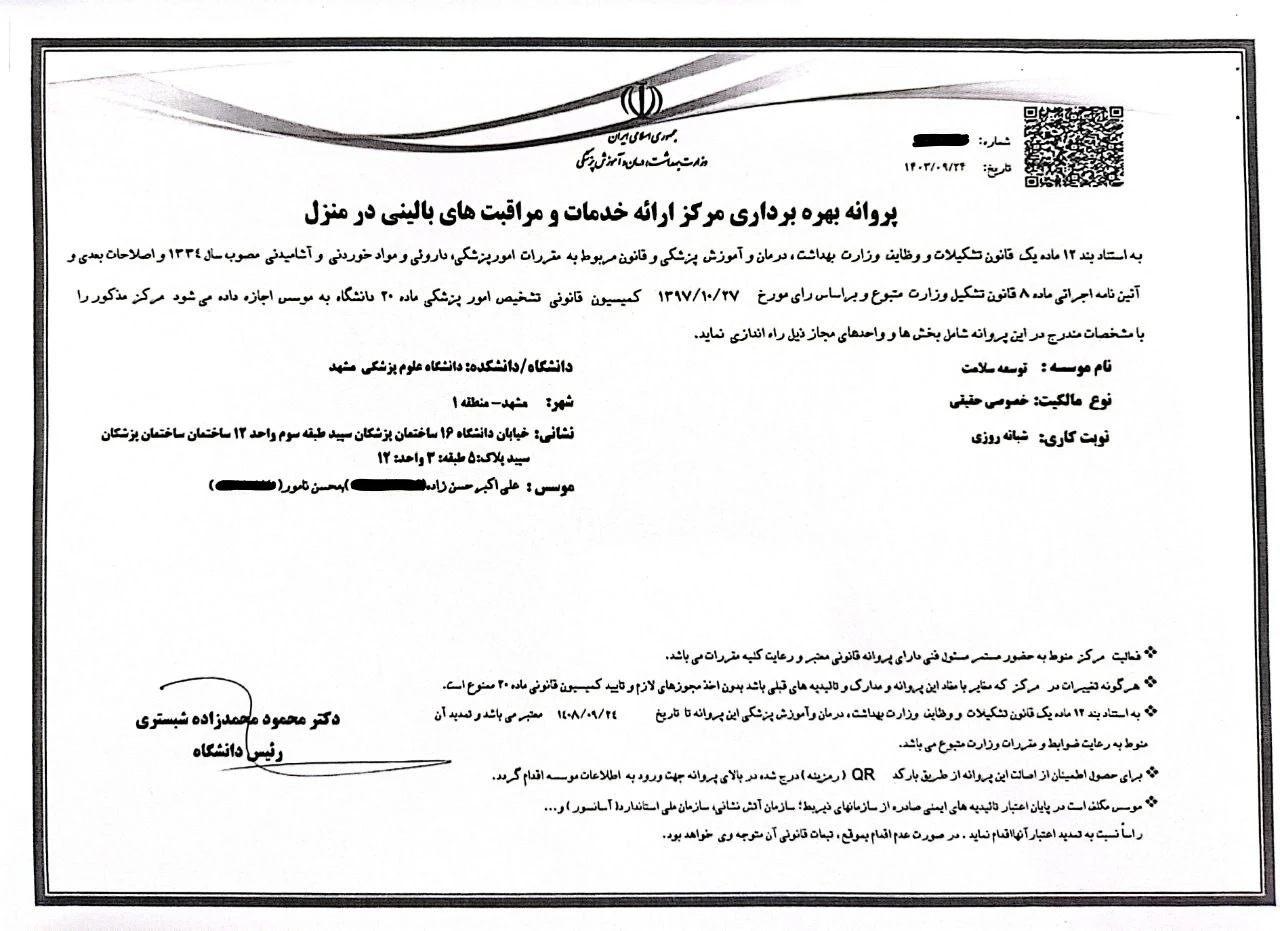
Tose Salamat clinical care centre, Mashhad
Tose Salamat clinical care centre in Mashhad, with an experienced and committed team of urologists, trained urology nurses and rehabilitation specialists, provides urology home visits, advice and diagnostic and treatment procedures throughout Mashhad. Using standard portable equipment and following full hygiene and aseptic protocols, the centre brings safe, effective treatment to patients in the warmth of their own homes.
To arrange a urologist home visit, catheter changes of all types, ultrasound at home or treatment advice, call +98 930 900 9159.
Frequently asked questions
Which conditions is a urologist home visit used for?
This service is vital for controlling and treating severe pain from passing a kidney stone (renal colic), urinary retention caused by benign prostate enlargement (BPH), severe urinary tract infections and bladder problems in older and frail patients.
If the urinary passage is blocked, will a urologist catheterise the patient at home?
Yes. When a patient (especially an older man with prostate problems) has urinary retention and catheterisation by a nurse is difficult or causes bleeding, the urologist carries out the catheterisation skilfully, with minimal pain, under sterile conditions at home.