
Description
Blood tests at home in Mashhad: a complete guide to on-site clinical laboratory services
Routine and diagnostic tests are one of the cornerstones of prevention, diagnosis and disease control in modern medicine. Yet going to a medical laboratory in person brings many difficulties: heavy city traffic, crowded labs and long queues, the risk of exposure to infections in healthcare settings, and the difficulty some patients have in travelling. In Mashhad, home laboratory sampling has become an efficient, safe and modern solution that allows a wide range of blood, urine and other tests to be done in the safety and calm of your home. The service is carried out by experienced staff, following full hygiene protocols and sample-transport standards, so that the accuracy of the results is fully preserved.
Why on-site sampling matters
Many people cannot get to a lab because of their physical condition or lack of time. On-site sampling allows the diagnostic process to go ahead without stress or physical exhaustion for the patient. It is especially important for people with chronic diseases who need regular monitoring of blood values. By removing the journey across the city and the wait in crowded clinical settings, diagnosis and treatment move faster and more smoothly.
Who needs home laboratory sampling?
A wide range of people can benefit from this clinical service.
Older people, because of physical frailty, joint pain or cognitive conditions such as Alzheimer’s disease, often cannot stand in lab queues for hours or cope with journeys across the city. For them, having tests done in the familiar surroundings of home prevents anxiety and exhaustion.
Patients with limited mobility or physical disabilities, for example after spinal cord injury, stroke or major orthopaedic surgery, need special transfer and the help of several people to leave home. Home sampling solves this major problem for families.
Patients receiving intensive care at home, who rely on support equipment such as ventilators or oxygen concentrators, should not be moved except in an emergency. For them, a lab technician at the bedside is the only practical way to check their biochemistry and blood counts.
Children and babies are often very afraid of clinics, white coats and needles, and a frightened child makes safe, accurate sampling difficult. Doing it at home, in a parent’s arms, keeps the child’s stress to a minimum and helps them cooperate.
Pregnant women, who need regular checks of blood sugar, thyroid hormones and blood values during this sensitive time, can avoid exposure to infectious illnesses in lab waiting rooms.
Busy working people who cannot take time off to spend several hours at a lab early in the morning for fasting tests can arrange for samples to be taken at home or at work before their working day begins.
Symptoms that need prompt laboratory testing
Some clinical signs point to sudden changes in metabolism or the immune system and should be checked quickly with a blood test:
Persistent, severe weakness and fatigue, which may be a sign of severe anaemia, thyroid problems or deficiency of vital vitamins such as vitamin D and the B vitamins.
Frequent or burning urination, or a change in the colour or smell of urine, which may point to a urinary tract infection or large swings in blood sugar and needs a full urine test and culture.
Sudden, unexplained weight loss or gain, which calls for tests of endocrine hormones, including thyroid and adrenal hormones.
Prolonged fever without a clear cause, which needs a full blood count, ESR and other markers of infection.
Unexplained bruising or frequent nose and gum bleeding, which may point to clotting disorders or a severe fall in platelets.
Practical reasons to choose home sampling
Besides convenience, this approach is recommended on the basis of infection-control standards and better care.
Reducing exposure to hospital infections and seasonal viruses is one of the main reasons. Healthcare settings naturally gather sick people, and people with weak immune systems who go there face a higher risk of picking up another illness.
Fasting can also be managed more safely. Traditionally the patient has to travel a long way while fasting, which in people with diabetes or in pregnancy can cause a sudden fall in blood sugar and even fainting. With sampling at the bedside, the patient can eat as soon as the sample has been taken.
Fast delivery of the sample to the reference laboratory at a controlled temperature ensures accurate results. The technician places samples straight into special insulated transport boxes kept cool with ice packs to prevent cell and enzyme breakdown.
Benefits of home sampling in Mashhad
One of the biggest benefits is the saving in time and travel costs. Families no longer need to arrange an accessible vehicle or several people to help the patient. Registration of the prescription and admission are done digitally, and results are sent online, so there is no need for another trip to collect them. The patient’s calm during sampling also prevents false changes in stress-sensitive values such as blood pressure, heart rate and the hormone cortisol.
Possible drawbacks and how they are managed
The most common difficulty in home sampling is a patient with hard-to-find veins, because of dehydration or vascular disease. In a lab, extra staff are on hand. To manage this, reputable centres send only senior, experienced adult and paediatric technicians who are highly skilled at finding veins. Another possible issue is delay in getting the sample to the lab because of traffic, which is fully addressed by planning technicians’ routes by area and using standard cooled transport equipment.
When home sampling is not appropriate
In emergencies, such as a marked drop in consciousness, active heavy bleeding, severe chest pain or anaphylactic shock, home sampling is the wrong choice. In these situations the first priority is to call the emergency services and get the patient quickly to the nearest hospital emergency department, where any tests should be done.
How to prepare before sampling
Following the instructions before a test carefully has a direct effect on the accuracy of the results.
The patient should fast for the exact time required by the test. Blood sugar tests usually need 8 hours of fasting, and blood fats such as cholesterol and triglycerides need 10 to 12 hours. Drinking a moderate amount of water is fine during this time, but tea, coffee, smoking and chewing gum are not.
Tell the technician about all medicines being taken, including heart, blood pressure and diabetes medicines and vitamin supplements, because some, such as biotin or corticosteroids, can interfere with hormone results. Medicines should only be stopped or taken before a test on the instructions of the treating doctor.
For a urine culture, the patient should wash the genital area with water before giving the sample and use the sterile container provided, passing the first part of the urine into the toilet and collecting the midstream portion in the container.
Steps of home laboratory sampling
When the technician arrives, they first check the patient’s identity and insurance booklet or electronic prescription to confirm which tests are needed. They then prepare sterile, single-use equipment and help the patient into a comfortable position (sitting or lying down).
The site is cleaned with an alcohol swab and a tourniquet is applied a suitable distance above the elbow. Once a suitable vein is found, the sample is taken with a standard syringe or a vacuum collection system. Tubes containing blood are gently inverted straight away to mix with the anticoagulant inside. Finally, each tube is labelled with the patient’s full details and a unique barcode, and the samples are placed in a cooled transport bag.
Care after sampling
After the needle is removed, the patient or a family member should press firmly and continuously on the site with dry cotton wool for 3 to 5 minutes. Avoid bending the elbow, as this can cause blood to collect under the skin and form a bruise (haematoma). If the patient takes blood thinners such as warfarin or clopidogrel (Plavix), pressure should be applied for longer until bleeding stops completely. For a few hours after the test, avoid heavy work or lifting with the arm used for sampling.
Possible side effects and how to handle them
Taking blood is a low-risk procedure but may cause minor side effects. A bruise at the site is usually caused by a small amount of blood leaking into the surrounding tissue; it is not dangerous and fades within a few days. An ice pack in the first 24 hours and then a warm compress help it heal faster. Feeling dizzy or slightly faint during or after sampling is common, especially in sensitive people; the patient should lie down for a few minutes with their legs raised and then have a sweet drink.
Risks of non-standard sampling
Using unqualified people or poor hygiene can bring serious risks. Shared syringes or non-sterile equipment can transmit dangerous viral infections such as hepatitis B, hepatitis C and HIV. Clumsy technique can injure nerves next to the vein, damage the vessel wall and cause local infection (cellulitis). For this reason the service must always be provided by licensed healthcare staff or staff officially introduced by a reputable centre.
Common mistakes with home tests
A common mistake is not telling the technician exactly when the last dose of medicine was taken. Another is heavy physical activity or exercise before the test, which can falsely raise muscle enzymes such as creatine kinase. Leaving a urine or stool sample at room temperature for a long time before the technician arrives also lets bacteria grow and cells break down, giving misleading culture results.
Myths about blood tests at home
Many people think tests done at home are less accurate than those done at a lab. This is not true: the analysers and test kits are the same for both, and the only difference is where the blood is taken. As long as the sample is transported at the right temperature, the result is no different. Another myth is that home sampling is very expensive; when the costs of transporting the patient, time off work and the difficulty of travelling are counted, the service is very good value.
Home sampling compared with going to the lab
At the lab, the patient usually has to attend early in the morning, at the busiest time, in a room full of other patients, which is physically and mentally stressful. Home sampling takes place in a calm setting, with no time lost in admission or payment queues and with the technician focused entirely on one patient. This calm is particularly helpful when monitoring heart patients and blood sugar.
Family checklist for home sampling
Have the doctor’s prescription or the electronic prescription tracking code ready before the technician arrives.
Follow the fasting time exactly as advised by the centre.
Drink enough water a few hours before the test so the veins are easier to find.
Prepare a bright, clean space with a comfortable chair or suitable bed for the patient.
Tell the technician about any allergy to alcohol swabs or plasters, or any history of fainting during blood tests.
Specialists’ advice on home testing
Doctors stress that test results should always be interpreted together with the patient’s symptoms. Routine tests such as blood fats, blood sugar, kidney and liver function and vitamin levels are recommended at least once a year for people over 40. Doctors also advise always using centres licensed by the Ministry of Health so that the chain of sample transport from home to laboratory is not broken.
Frequently asked questions
Can specialist and hormone tests also be done at home?
Yes. All routine, specialist and hormone tests, pregnancy screening, Pap smears, genetic tests and bacterial culture samples can be collected at home.
How and when will we receive the results?
Once the results are ready at the reference laboratory, they are sent to the patient by text message, email or messaging apps. Timing depends on the test: routine tests are usually ready by the end of the same day, while specialist tests and cultures take a few days.
Do health and supplementary insurance cover home sampling?
The official invoice issued by our partner reference laboratory can be submitted to insurers and supplementary insurance schemes for reimbursement according to the approved tariff.
How are samples taken from newborn babies?
For newborns we use senior neonatal technicians with special skill in sampling from tiny veins, and if needed they take a capillary heel-prick sample.
Can I request tests without a doctor’s prescription?
Yes. Routine check-up tests can be requested without a prescription, and the centre’s admission system can register the relevant test codes.
How should a urine sample be stored until the technician arrives?
The urine sample should be collected in the special sterile container and kept in the fridge. It is better to collect the urine sample while the technician is at your home.
What happens if the patient’s vein cannot be found?
Our technicians carry vein-finding devices, and in the very rare cases where sampling is not successful, a senior nurse or an alternative method is arranged.
Does the three-month blood sugar test need fasting?
No. The HbA1c test, which shows the average blood sugar over the past three months, does not need fasting and can be done at any time of day.
What time of day is best for home sampling?
For most tests the best time is between 7 and 10 a.m., so that the body’s natural morning state and fasting are properly maintained.
Can I send a photo of the prescription?
Yes. You can send a clear photo of the doctor’s prescription to the centre’s staff via a messaging app so that registration and the cost can be worked out before the technician is sent.
Summary
Home laboratory sampling in Mashhad is an effective step towards better public health and easier access to specialist care. As a safe link between the home and reference laboratories, it removes the worry of moving hard-to-transport patients, children and older people. Following scientific standards at every stage of sampling, keeping the cold chain during transport and fast admission ensure accurate, high-quality results. By choosing this service, families can monitor their own health and that of their loved ones quickly and with the highest level of safety.
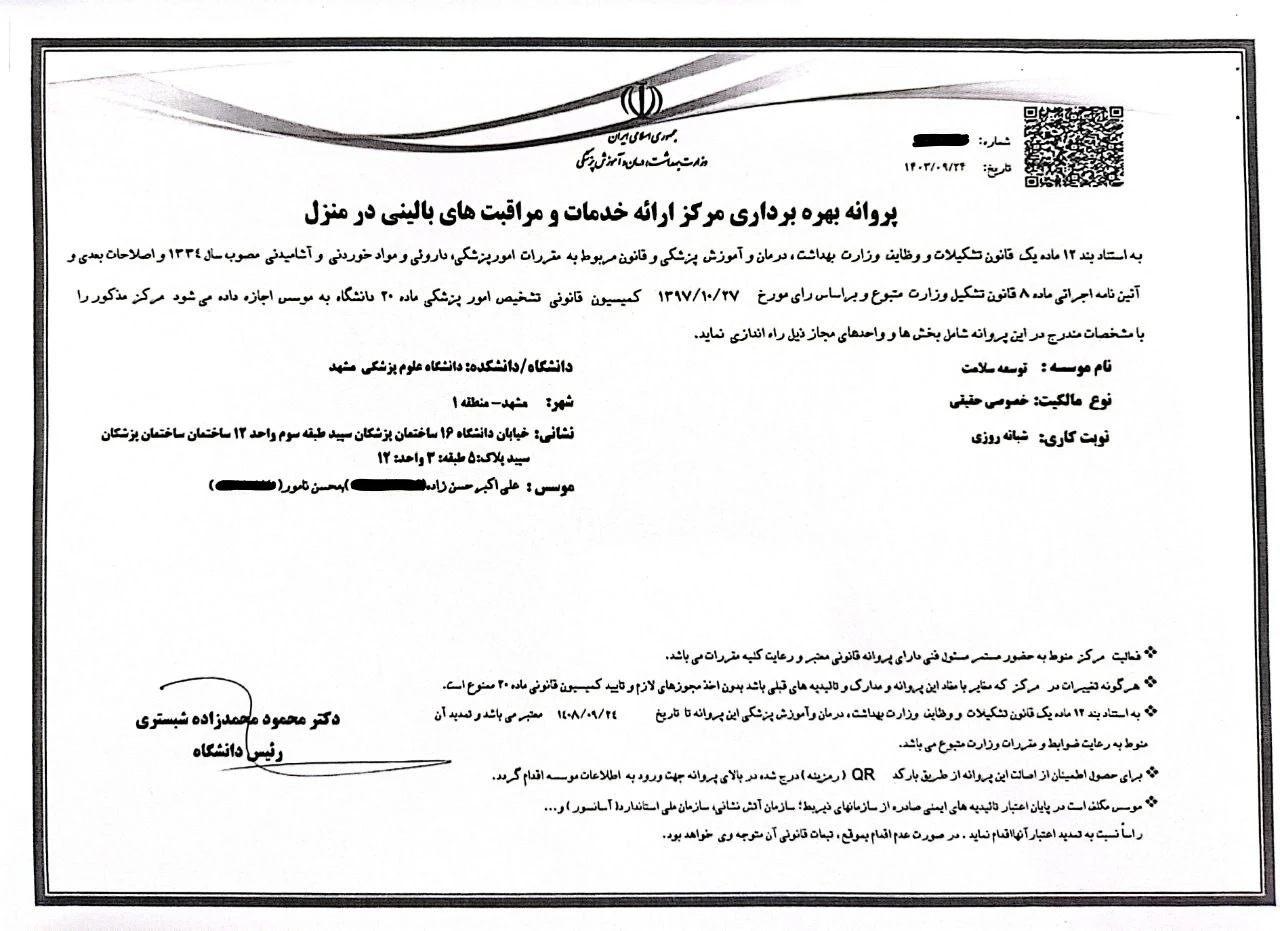
Tose Salamat clinical care centre, with experienced doctors, nurses and healthcare staff, provides treatment and care at home and, when needed, in healthcare centres in Mashhad. For advice and to arrange services, call +98 930 900 9159.