
Description
A doctor at home in Mashhad: medical care at home with calm, accuracy and time saved
Illness never comes at a convenient time. Sometimes the patient is an older person who cannot leave home, a child with a high fever, or someone who needs an examination after surgery and is hard to move.
In these situations, a doctor’s home visit can be the right way to assess, diagnose, start treatment and decide on next steps. At the patient’s home, the doctor takes a history, carries out a physical examination and, if needed, prescribes medicine or requests tests, imaging or hospital referral. For some patients — especially older and frail people — this can be a good alternative to a clinic visit, but it does not replace going to hospital in an emergency.
What is a doctor’s home visit?
The doctor comes to where the patient lives and provides, as far as possible, the same basic services available in a surgery or clinic. These may include:
- Taking a detailed history
- A full examination
- Checking vital signs
- Initial diagnosis
- Prescribing medicine
- Requesting tests or imaging
- Reviewing how treatment is going
- Advice for the patient and family
- Deciding whether hospital admission is needed
The biggest advantage of a doctor at home
The greatest benefit is making the right decision. Many families do not know whether the patient really needs to go to hospital. After examining the patient, the doctor can decide whether:
- Treatment can continue at home.
- Tests are needed.
- An X-ray or ECG should be done at home.
- The patient should be referred to a specialist.
- Or, if there are danger signs, the patient must go to the emergency department straight away.
This evidence-based decision avoids unnecessary trips to medical centres — and, just as importantly, avoids delays in treating emergencies.
What does a GP do at home?
The GP is the first level of medical care and can assess and treat many common problems, including:
- Fever and chills
- Colds
- Flu
- Sore throat
- Cough
- Mild to moderate shortness of breath (after assessment)
- Diarrhoea and vomiting
- Dehydration
- Abdominal pain
- Headache
- Muscle pain
- Joint pain
- Skin infections
- Blood pressure control
- Diabetes control
- Check-ups for older people
- Follow-up of chronic illness
- Examining patients confined to bed at home
- Assessing patients after surgery
How does a home visit work?
Many people think a home visit is just about writing a prescription, but it includes a set of diagnostic and treatment steps that help the doctor assess the patient accurately. A visit usually includes:
1. Taking the history
The doctor asks about the reason for the visit, when symptoms started and how severe they are, previous illnesses, current medicines, drug allergies and medical history. A careful history is one of the most important steps in diagnosis.
2. Checking vital signs
Depending on the patient’s condition, the doctor may check:
- Blood pressure
- Pulse
- Temperature
- Breathing rate
- Oxygen saturation (if needed)
3. Physical examination
Based on the complaint, the doctor examines the heart, lungs, abdomen, ears, nose and throat, skin, limbs and nervous system as needed.
4. Initial diagnosis and treatment plan
The doctor gives an initial diagnosis and sets a plan, which may include medicine, care advice, rest, dietary changes and follow-up in the coming days.
5. Requesting tests and services at home
If needed for a more precise diagnosis, the doctor may recommend services at home, such as:
- Blood and urine tests
- Electrocardiogram (ECG)
- Portable X-ray
- IV therapy
- Injections
- Catheter change
- Wound dressing
- Physiotherapy
This allows many patients to continue diagnosis and treatment without going to a medical centre.
6. Referral to a specialist or hospital when needed
One of the doctor’s most important tasks is recognising when home treatment is not enough. If there are warning signs, the doctor will refer the patient to a specialist or to hospital.
When is a home visit the best choice?
A home visit is not needed for every illness, but it is a good choice in many situations:
Older people
Because of mobility problems, chronic illness or the risk of falls, older people usually benefit most.
Patients confined to bed at home
Patients recovering at home after a stroke, surgery, a fracture or advanced illness usually need regular doctor’s visits.
People with limited mobility
People with spinal cord injury, neurological disease or physical disability may not be able to get to a surgery easily.
Children
Examining a child in the calm of home can reduce stress and make the child more cooperative.
Patients with mild infectious illness
When the doctor finds the patient stable, a home visit avoids spreading illness in medical settings and unnecessary time in crowded places.
Advantages of a doctor’s home visit
Less travel and fatigue
Moving patients — especially older or frail people — can be difficult and even dangerous. A home visit largely solves this.
Saving time
No long waits in surgeries or clinics; many services are done at home.
Seeing the patient’s living conditions
At home the doctor can see nutrition, safety, how medicines are stored and the care arrangements, and give more practical advice.
Less exposure to infections in medical centres
For some patients, especially those with weak immunity, fewer unnecessary visits to medical centres means less contact with infections.
Better coordination with other services
If needed, the doctor can add nursing, lab tests, X-ray, ECG or physiotherapy at home to the treatment plan.
Limitations of a home visit
Although it has many advantages, a home visit does not replace the emergency department or hospital in every situation. Surgery, advanced imaging (such as CT or MRI), intensive care (ICU), some specialist tests and complex emergency treatment all require a medical centre.
When should you call emergency services directly?
With any of the following, call emergency services immediately instead of waiting for a home visit:
- Severe chest pain or pressure
- Severe shortness of breath
- Reduced consciousness
- Seizure
- Severe, uncontrolled bleeding
- Sudden weakness or numbness on one side of the body
- Sudden difficulty speaking
- Extensive burns
- Serious injuries from an accident
- A severe allergic reaction with swelling of the face or throat
These conditions can be life-threatening and need immediate care.
Which conditions can a GP usually assess and treat at home?
The GP can assess and treat many common illnesses, or refer to a specialist when needed:
Respiratory illness
- Colds
- Flu
- Sore throat
- Sinusitis
- Cough
- Fever
- Mild bronchitis
If there is severe shortness of breath, blue lips or reduced consciousness, the patient must go to the emergency department straight away.
Digestive illness
The doctor can assess patients with diarrhoea, vomiting, abdominal pain, constipation, indigestion or dehydration, and arrange treatment or further tests if needed.
Chronic illness
Patients with high blood pressure, diabetes, heart disease, lung disease, asthma or thyroid disease need regular follow-up; home visits can help control these conditions better.
Older people
The doctor can assess general condition, nutrition, medicines, risk of falls, memory problems, bedsores and control of chronic illness.
Patients after surgery
Recently operated patients may need a home visit to check recovery, control pain, assess the wound or adjust treatment.
Myths about a doctor at home
“A doctor at home has no diagnostic tools.”
Not true. Some specialist procedures are only done in hospital, but with a clinical examination, history, vital signs and services at home such as blood tests, ECG or portable X-ray, the doctor can get enough information to make treatment decisions.
“Home visits are only for older people.”
No. Anyone who cannot easily get to a medical centre because of illness, limited mobility, recovery, high-risk pregnancy or other circumstances may benefit.
“If the doctor comes home, there’s no need for hospital.”
A home visit does not replace the emergency department or hospital. If the doctor finds that the patient needs specialist facilities or hospital care, they will recommend transfer.
Common mistakes families make
- Giving antibiotics before the doctor’s visit
- Using medicines left over from old prescriptions
- Hiding medical history or current medicines
- Stopping prescribed medicines without advice
- Delaying calling the doctor despite warning signs
- Moving the patient unsafely by private car in an emergency
How to prepare for a doctor’s home visit
- Have the patient’s ID and medical records ready.
- Give the doctor a list of current medicines.
- Have previous test results, imaging or medical files ready.
- Mention any drug allergies.
- Note the symptoms, when they started and how they have changed.
Frequently asked questions
Can the doctor issue an electronic prescription at home?
Where the necessary conditions and systems are in place, the doctor can issue an electronic prescription or a prescription in line with current regulations.
Does the doctor also visit children at home?
Yes. In many cases a GP can examine children too; if a specialist assessment is needed, the child is referred to a specialist.
Can the doctor request tests or imaging?
Yes. If needed, the doctor may request tests, an ECG or an X-ray, and in some situations these can also be done at home.
Does the doctor issue sick notes?
Any medical certificate is subject to the law, regulations and the doctor’s judgement, and is issued only when the necessary conditions are met.
Can every illness be treated at home?
No. Some illnesses and emergencies need hospital facilities, advanced imaging, surgery or intensive care.
Doctor’s note
A doctor’s home visit is most valuable as part of a regular care plan, not just when someone falls ill. Regular follow-up of older people, patients with chronic illness and patients confined to bed at home helps spot problems early and prevent complications.
When should you not wait for a home visit?
Call emergency services immediately if there is severe chest pain, severe shortness of breath, reduced or lost consciousness, a seizure, heavy bleeding, signs of stroke (drooping face, one-sided weakness or slurred speech), extensive burns, serious accident injuries, or a severe allergic reaction with swelling of the tongue or throat.
Summary
A doctor’s home visit is one of the most effective health services for people who cannot easily reach medical centres because of illness, old age or limited mobility. Through careful assessment, initial diagnosis, starting treatment, follow-up of chronic illness and arranging tests, X-ray or ECG, it covers a large part of patients’ medical needs at home.
Recognising in time when a patient needs hospital is just as important. That is why home visits must be carried out by a qualified doctor, and if there are warning signs, fast transfer to a medical centre comes first.
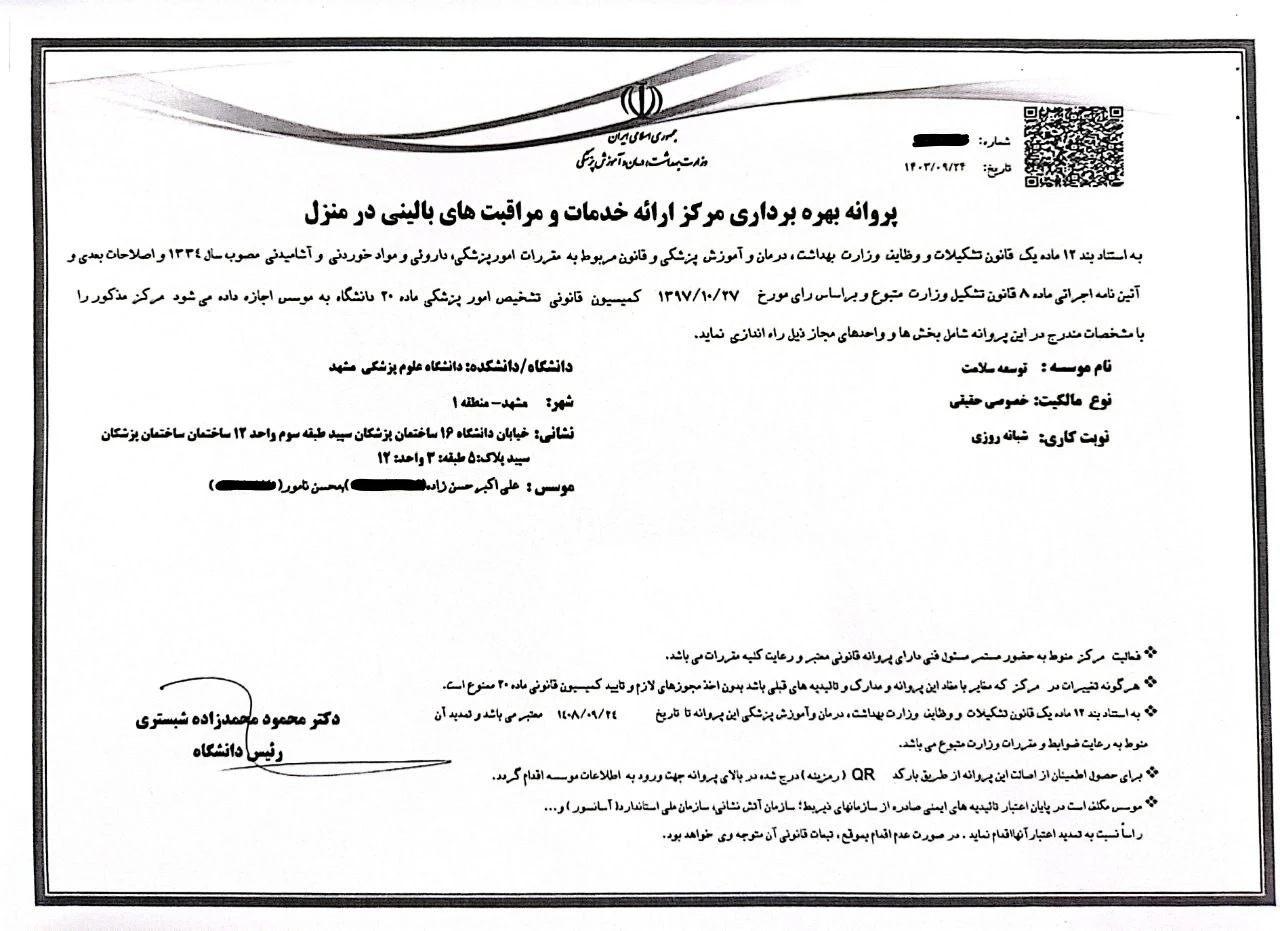
If home treatment and follow-up are suitable for you or a family member, the Tose Salamat home clinical care centre provides doctor’s home visits in Mashhad with experienced GPs and nursing staff. If needed, we also arrange lab tests at home, portable X-ray, ECG, injections, IV therapy, catheter care, wound dressing and nursing care. For more information or to book, call +98 930 900 9159.