
Description
Ultrasound at home in Mashhad
Ultrasound is one of the most widely used medical imaging methods. It uses high-frequency sound waves to give the doctor images of organs, tissues and blood flow. It does not use ionising radiation and is a safe, non-invasive method for many diagnostic examinations.
For some patients, going to an imaging centre is difficult because of old age, limited mobility, chronic illness or recovery after surgery. In these situations, portable ultrasound scanners make it possible to carry out some examinations at home. However, a home ultrasound must be requested by a doctor and performed by a trained professional with suitable equipment — and not every type of ultrasound can be done at home.
What is ultrasound?
Ultrasound (sonography) is a way of looking at the body’s internal organs: sound waves are sent into the body and their echoes are turned into images.
It is used to examine many organs, including:
- Liver
- Gallbladder
- Kidneys
- Bladder
- Spleen
- Thyroid
- Uterus and ovaries
- Prostate
- Blood vessels (in Doppler ultrasound)
- Soft tissues
Unlike X-rays, ultrasound does not use radiation, and in many cases it is the first imaging method of choice.
Which patients most often need an ultrasound at home?
Older people
Moving older people, especially those with mobility problems or chronic illness, can be difficult; an ultrasound at home makes the process easier.
Patients confined to bed at home
People confined to bed at home because of serious illness, spinal cord injury, stroke or similar conditions may benefit from portable imaging on their doctor’s advice.
Patients after surgery
Sometimes the doctor requests an ultrasound to follow up treatment or check for complications; if the patient cannot leave home, doing it at home can be a good option.
Patients with limited mobility
People who cannot easily get to medical centres because of fractures, neuromuscular disease or other problems may benefit from this service.
Patients needing special care
Some patients cared for at home can have a portable ultrasound when imaging is needed and the doctor agrees.
Which types of ultrasound can be done at home?
Depending on the patient’s condition, the doctor’s request and the equipment available, some of the following may be done at home:
- Abdominal ultrasound
- Pelvic ultrasound
- Kidney and urinary tract ultrasound
- Bladder ultrasound
- Thyroid ultrasound
- Soft tissue ultrasound
- Doppler ultrasound of some vessels (when equipment and conditions allow)
Note: not every type of ultrasound — especially some specialist examinations — can be done at home, and a visit to an imaging centre may be needed. The service is decided according to the doctor’s request and the equipment available.
Advantages of ultrasound at home
- Less need to move patients
- More comfort for older people and patients confined to bed
- Less exposure to crowded medical settings
- Diagnostic examinations in the home environment
- Suitable for patients with limited mobility
- Saves time for family and carers
- Can be coordinated with other medical services at home
How to prepare for an ultrasound at home
Preparation depends on the type of examination. Following these tips helps get better-quality images and, in some cases, avoids having to repeat the scan.
Abdominal ultrasound
For many abdominal scans, the doctor may recommend fasting for 6 to 8 hours. This reduces bowel gas and gives a better view of organs such as the liver and gallbladder.
Bladder and pelvic ultrasound
In many cases the bladder needs to be full. The patient is usually asked to drink a set amount of water about an hour before the scan and not to pass urine until it is finished.
Kidney ultrasound
Depending on the doctor’s request, a full bladder or other preparation may be needed.
Thyroid, soft tissue and vascular ultrasound
These examinations usually need no fasting or special preparation, unless the doctor says otherwise.
Note: the instructions of your doctor or the service provider always come first, because the type of ultrasound can change the preparation needed.
Abdominal ultrasound at home
Abdominal ultrasound is one of the most common types and is used to examine organs such as:
- Liver
- Gallbladder
- Bile ducts
- Spleen
- Pancreas (as far as it can be seen)
- Abdominal aorta
- Part of the kidneys
The doctor may request it for abdominal pain, gallstones, liver disease, abdominal masses or other problems.
Kidney and urinary tract ultrasound
This type of ultrasound can help assess:
- Kidney stones
- Dilatation of the urinary system
- Kidney cysts
- Some masses
- Kidney size
- The bladder
In patients with urinary retention or voiding problems, it may be combined with a bladder examination.
Bladder ultrasound
This examination is usually requested to assess:
- Post-void residual urine volume
- Bladder emptying problems
- Some masses
- The prostate (indirectly, in some situations)
Doppler ultrasound
Besides showing the structure of blood vessels, Doppler ultrasound also assesses blood flow.
Uses include:
- Checking for a possible blood clot (DVT)
- Assessing blood flow in the limbs
- Investigating some vascular diseases
- Following up some heart and vascular patients (at the doctor’s request)
Whether this type can be done at home depends on the scanner and equipment available.
Ultrasound in pregnancy
Ultrasound in pregnancy is one of the most important tools for monitoring the health of mother and baby.
However, not every pregnancy scan is suitable for home. The type of scan, the stage of pregnancy and the purpose must be decided by the doctor. In some cases, more advanced equipment or specialist assessment makes a visit to an imaging centre necessary.
Are portable ultrasound scanners accurate enough?
Portable scanners have improved considerably in recent years and, used by a trained professional, can give the doctor valuable information in many clinical situations.
Image quality depends on several factors, including:
- The type of scanner
- The operator’s skill
- The patient’s condition
- The type of ultrasound
- The purpose of the examination
For some complex conditions, the doctor may recommend a scan with advanced hospital equipment.
Limitations of ultrasound at home
Although home ultrasound has many advantages, it also has limitations. For example:
- Not every type of ultrasound can be done at home.
- Some specialist examinations need more advanced equipment.
- If further procedures are needed, the patient must go to a medical centre.
- Image quality may sometimes be affected by the patient’s condition or the surroundings.
That is why the decision to scan at home should be based on the doctor’s request and the equipment available.
Common patient mistakes
Some mistakes can lower the quality of the examination or delay diagnosis:
- Not fasting when the doctor has recommended it.
- Emptying the bladder before a pelvic or bladder scan when it should be full.
- Not having the doctor’s request or previous records ready.
- Thinking ultrasound can replace every other imaging method.
- Delaying the examination despite warning symptoms.
Myths about ultrasound
“Ultrasound uses radiation.”
No. Ultrasound is based on high-frequency sound waves and uses no ionising radiation.
“Any ultrasound can be done at home.”
No. Whether a scan can be done at home depends on the type of examination, the equipment available and the doctor’s opinion.
“If the ultrasound is normal, there is no need to see the doctor.”
An ultrasound result is only part of the diagnostic picture and must be interpreted by a doctor together with the symptoms, examination and other tests.
Is a home ultrasound accurate enough?
One of the most common questions is whether portable scanners are as accurate as those in imaging centres.
It depends on the examination. Today’s portable scanners give good quality in many clinical uses and, in experienced hands, provide valuable information for the doctor’s decisions.
However, for some specialist examinations, or when more advanced equipment is needed, the doctor may recommend a scan at an imaging centre. So the place of the scan should be chosen according to the patient’s condition and the diagnostic aim, not just convenience.
Benefits of ultrasound at home
When patients are chosen correctly, a home ultrasound has several benefits:
- Less need to move older or bedbound patients
- No exhausting trips
- Less exposure to crowded medical settings
- The examination takes place in the calm of home
- Suitable for patients with limited mobility
- Saves time for the patient and family
- Can be coordinated with other home services such as a doctor’s visit or lab sampling
When is an ultrasound at home not suitable?
Although this service helps many patients, it is not possible in every situation. The doctor may prefer an imaging centre when there is:
- A need for highly specialised ultrasound
- A need for other imaging at the same time
- An emergency requiring hospital facilities
- A need for the highest possible image quality
In these situations, accurate diagnosis and patient safety always come first.
Frequently asked questions
Does an ultrasound at home hurt?
No. Ultrasound is non-invasive and usually painless. The patient may feel slight pressure when the probe moves over some sensitive areas.
Do I need a doctor’s prescription for an ultrasound at home?
In many cases the scan is done on a doctor’s request or prescription, so that the type of examination and its diagnostic aim are clear.
Is the report ready the same day?
When the report is ready depends on the type of examination and the provider’s workflow.
Is an ultrasound at home suitable for older people?
Yes. Older people who cannot easily get to imaging centres because of mobility problems, chronic illness or their physical condition are among the main users of this service.
Is ultrasound at home done for pregnant women?
Depending on the type of scan, stage of pregnancy, the doctor’s request and the equipment available, some examinations may be possible at home. For specialist scans, the doctor may recommend an imaging centre.
Checklist before the ultrasound
Before the sonographer arrives, it helps to have ready:
☐ The doctor’s prescription or request
☐ ID and medical records
☐ Previous ultrasound results (if any)
☐ Related lab tests (if requested by the doctor)
☐ Fasting or a full bladder, if needed
☐ Enough space to set up the scanner
When should you see a doctor urgently?
If an ultrasound has been suggested along with any of these symptoms, do not delay going to a doctor or medical centre:
- Severe, sudden abdominal pain
- Heavy bleeding
- Reduced consciousness
- Severe shortness of breath
- Severe chest pain
- Signs of stroke
- Serious injuries from an accident
In such situations emergency care comes first, and the doctor will decide which imaging is needed.
Summary
Ultrasound at home is a valuable service for patients who cannot easily get to imaging centres because of old age, limited mobility, chronic illness or recovery. Using portable scanners and no ionising radiation, it makes many diagnostic examinations possible at home.
Not every type of ultrasound can be done at home, though, and the final decision on the type of examination and where it takes place should be based on the doctor’s opinion and the patient’s condition. Proper preparation, the patient’s cooperation and an experienced sonographer all play an important part in the quality of the results.
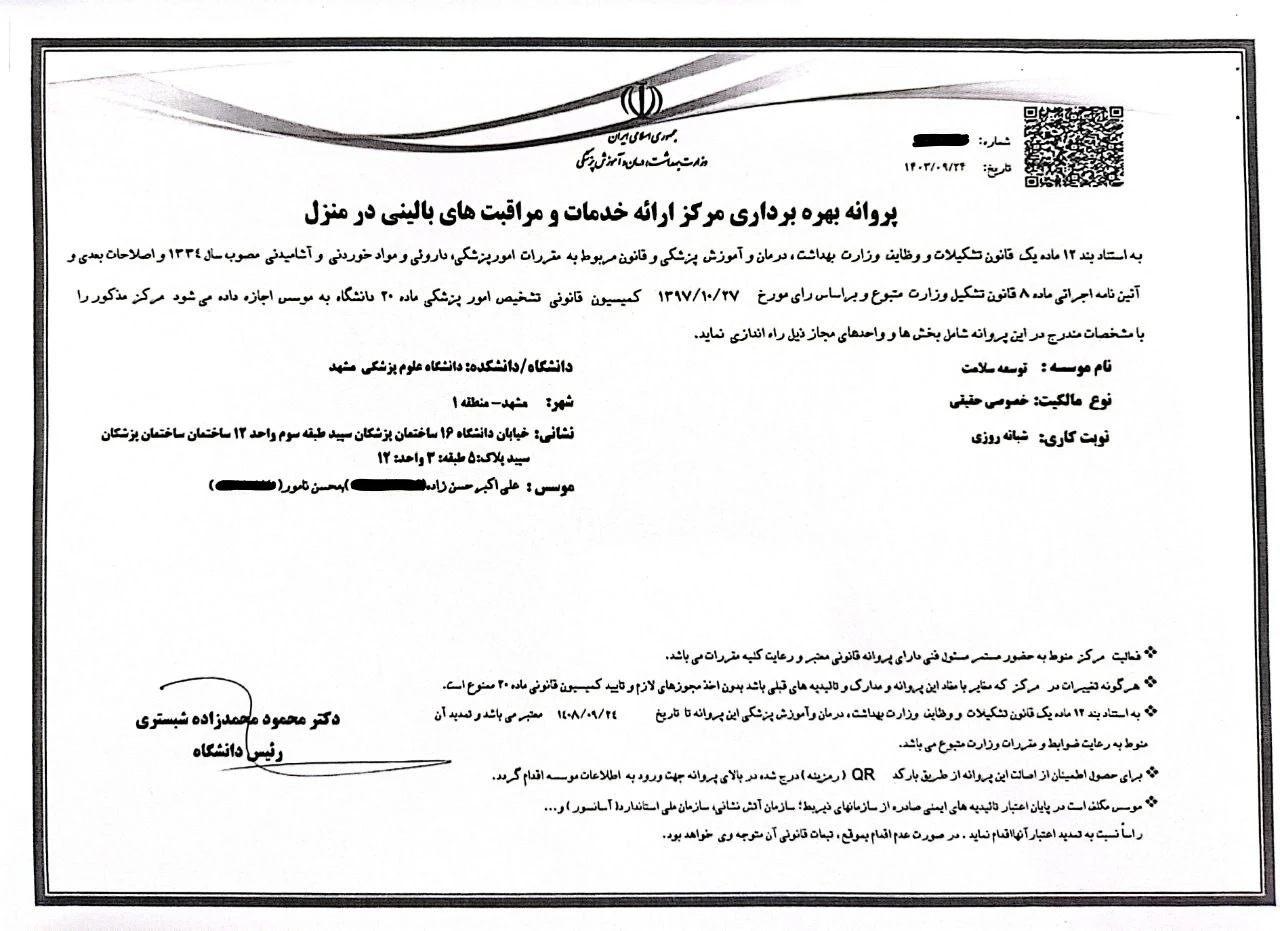
The Tose Salamat home clinical care centre provides ultrasound at home in Mashhad for suitable patients, with portable equipment and an experienced team. If needed, we can also arrange a doctor’s visit, lab tests at home, portable X-ray, ECG, injections, IV therapy, specialist wound dressing and other home nursing services at the same time. For more information or to book, call +98 930 900 9159.