Description
Echocardiography at home in Mashhad: a detailed heart check without moving the patient
Cardiovascular disease is one of the most common causes of hospital admission and death worldwide and in Iran. Timely, accurate and early diagnosis plays a vital role in saving lives and preventing irreversible complications.
Echocardiography (“heart echo”) is one of the main, safest and most accurate ways to assess the structure and mechanical function of the heart. But taking heart patients, older people, stroke patients or those in intensive care at home to a hospital for this test brings many challenges: stressful traffic, the risk of falls, long waits and the risk of hospital infections.
By offering echocardiography at home, performed by skilled specialists with advanced portable machines, Tose Salamat in Mashhad removes this major worry for families.
What is echocardiography and how does it work?
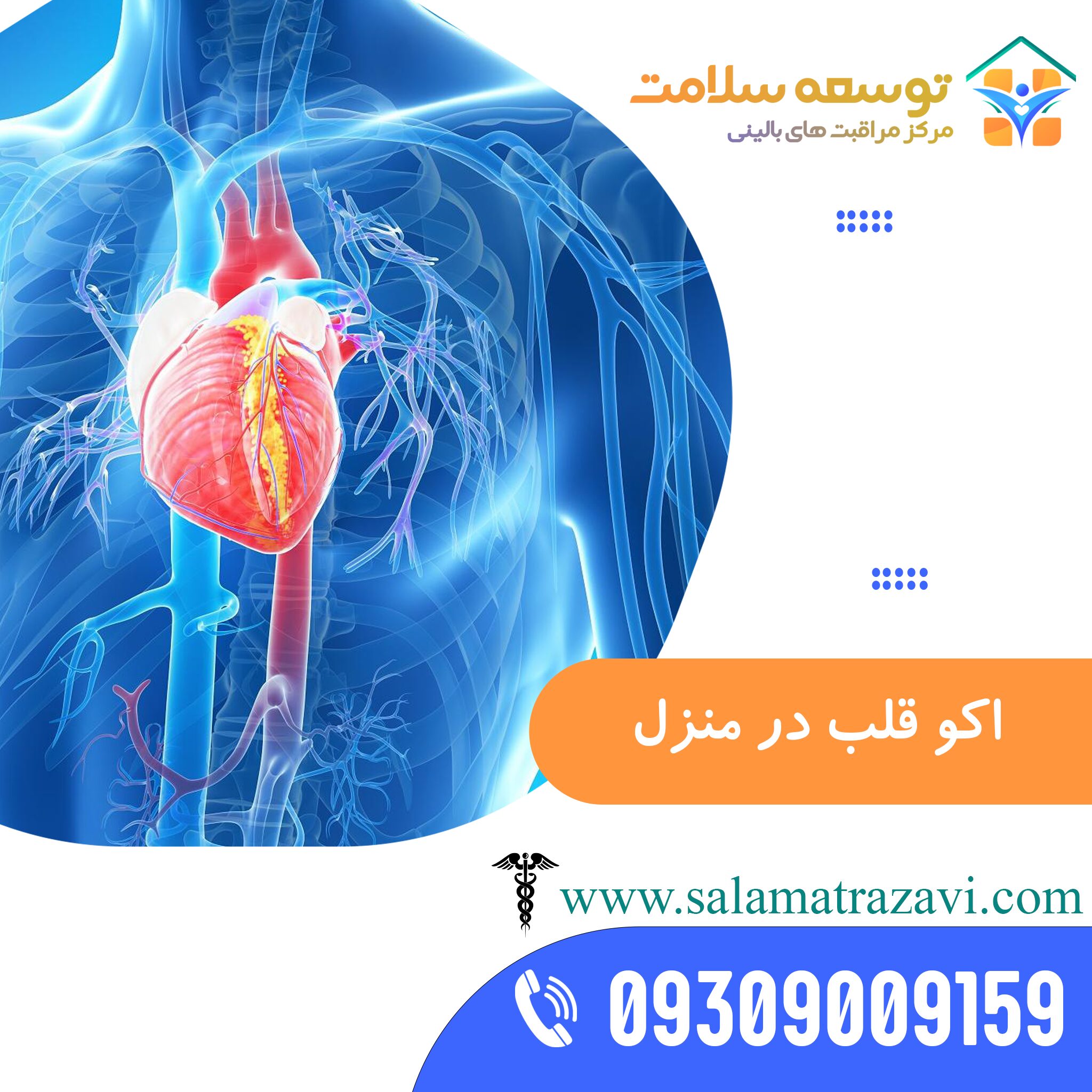
Echocardiography is a non-invasive, painless imaging method that uses high-frequency sound waves (ultrasound, beyond the range of human hearing) to create live, detailed images of the heart’s structure, walls, chambers and valves.
It uses no ionising radiation (such as X-rays), so it is completely safe for all age groups, including newborns, pregnant women and vulnerable patients.
The sound waves reflect off the heart tissue and flowing blood and are turned by advanced software into moving images, from which the specialist can examine the heart in full detail.
The many benefits of a heart echo at home in Mashhad
Having this test in the calm of home offers much more than convenience:
- No stress from transporting the patient: anxiety about leaving home, Mashhad’s heavy traffic and crowded hospitals can temporarily raise heart rate and blood pressure and affect the results. At home, the patient stays as calm as possible.
- Lower risk of infection: heart patients and older people have weaker immunity, and crowded surgeries and clinics greatly increase the chance of catching viral and other infections.
- Suitable for patients with severely limited mobility: people who cannot move because of stroke, major orthopaedic surgery, advanced Parkinson’s or Alzheimer’s disease or old age receive the service without an ambulance or wheelchair.
- Saving time and extra costs: no long queues, and families do not need time off work or special transport.
- Immediate explanation by the specialist: straight after the echo, the doctor explains the results to the patient and family and prescribes any treatment or medication changes needed.
Types of echocardiography that can be done at home
Modern portable equipment makes it possible to perform different types of echo at home with quality comparable to fixed hospital machines:
- 2D echocardiography: shows the overall structure of the heart, chamber size and wall thickness in cross-sectional images.
- Colour Doppler echocardiography: shows the direction and speed of blood flow inside the heart and great vessels, revealing valve narrowing (stenosis) or leaks (regurgitation).
- Tissue Doppler imaging (TDI): an advanced method for assessing how well the heart muscle contracts and relaxes.
Who most needs a heart echo at home?
Many clinical situations call for a cardiac assessment as quickly as possible without moving the patient:
- Older people with chronic heart disease who cannot get to a clinic.
- Patients recently discharged from hospital who need regular checks of their valves or heart function.
- People with sudden shortness of breath, vague chest pain, severe palpitations, swollen ankles and legs, or persistent dizziness.
- People with long-standing high blood pressure or diabetes who need regular checks of the effects on the heart muscle.
- Cancer patients on certain chemotherapy drugs that can damage the heart, for whom regular monitoring of ejection fraction (EF) is vital.
- Patients in home intensive care connected to a ventilator.
Key measurements recorded in the echocardiography report
During the home echo, the cardiologist assesses several vital factors:
- Ejection fraction (EF): the percentage of blood pumped out of the left ventricle with each beat. Normal is usually 50–70%; lower values indicate heart failure.
- Valve structure and function: the mitral, aortic, tricuspid and pulmonary valves are checked for narrowing (stenosis) or leaking (regurgitation).
- Chamber size: enlargement or thickening (dilatation or hypertrophy) of the ventricles and atria, which may result from high blood pressure or genetic conditions.
- Wall motion: areas of heart muscle moving poorly (hypokinesia or akinesia) because of previous heart attacks.
- Fluid around the heart (pericardial effusion): fluid collecting in the protective sac around the heart, which can impair its function.
How Tose Salamat performs a heart echo at home
The process is simple and uncomplicated for the patient:
- Booking and initial advice: call the centre and register the request based on the doctor’s prescription or the patient’s symptoms.
- Dispatch of the specialist team: a cardiologist comes to the patient’s address with a portable echo machine.
- Preparing the patient: the patient lies on their left side or back with the chest uncovered.
- Applying gel: a little water-based gel is applied to the chest so the sound waves travel well.
- Imaging: the doctor moves the probe over different points on the chest and reviews and records the images on screen.
- Analysis and report: after the test the gel is wiped off, a written report with printed or digital images is given to the family, and treatment is explained.
Heart warning signs you should not ignore
If you notice these signs in a family member at home, start diagnostic tests such as an echo and ECG straight away:
- Shortness of breath with very light activity or when lying flat (orthopnoea).
- Pressure, heaviness or burning in the middle of the chest that may spread to the left arm, jaw, throat or back.
- Sudden or gradual swelling of the legs, ankles or abdomen, a sign of fluid build-up from weak pumping.
- Extreme, unexplained tiredness even after enough rest.
- Sudden dizziness, light-headedness or fainting (syncope).
- Irregular heartbeat or a “skipped beat” feeling.
With severe chest pain or severe shortness of breath, call emergency services immediately rather than waiting for a home test.
The difference between an ECG and an echocardiogram
Many people confuse the two tests, but they do different things:
- ECG (electrocardiogram): records the heart’s electrical activity and is mainly useful for detecting rhythm problems (arrhythmias) and acute heart attacks at that moment.
- Echocardiogram: shows the heart’s mechanical structure, muscle movement, valves and blood flow. In short, the ECG checks the heart’s “wiring” and the echo checks its “plumbing and pump”. For a complete assessment both are often recommended together — and Tose Salamat offers both at home.
Equipment used for portable echocardiography
Today’s portable echo machines are advanced, compact systems — about the size of a large laptop or specialist tablet — with powerful image-processing software.
They come with specialist cardiac (sector) probes at variable frequencies, allowing good imaging even in heavier patients or those with lung problems. The quality of colour Doppler images and clarity of the heart’s inner lining let the doctor detect even small valve leaks or structural changes accurately.
Preparing for a heart echo at home
A big advantage of echocardiography is that it needs no complicated preparation:
- The patient does not need to fast and can eat and drink normally.
- All heart and blood pressure medicines should be taken as usual, unless the treating doctor says otherwise.
- Two-piece, comfortable clothing makes it easy to access the chest.
- Have previous medical records, prescriptions, old ECGs and chest X-rays ready before the doctor arrives.
After the test: next steps in treatment
After the echo and assessment, the cardiologist makes recommendations based on the findings:
- If the results are normal, the existing prevention and monitoring plan continues.
- If mild to moderate problems are found, heart medicines (such as diuretics, blood pressure medicines or beta-blockers) can be adjusted on the spot.
- If the results show an acute, urgent problem (such as a severe valve problem or a large effusion around the heart), the doctor orders immediate admission and the centre’s team arranges safe transfer to hospital.
Frequently asked questions about a heart echo at home in Mashhad
Are home echo results reliable and accurate?
Yes. Modern portable machines are comparable to hospital machines in image quality and in measuring parameters such as EF and valve function, and the specialist’s diagnosis at home is fully reliable.
How long does a home echo take?
The imaging and heart assessment usually take 20 to 40 minutes. Including reviewing records and writing the report, the whole visit takes about an hour.
Can we choose a male or female specialist?
Yes. Tose Salamat tries to send a specialist according to the patient’s and family’s preference and comfort.
Does a home heart echo hurt or have side effects?
No. It is completely non-invasive and painless. The only sensations are the coolness of the gel and gentle pressure from the probe on the chest.
Does insurance cover a home echo?
Many supplementary insurers cover home diagnostic services with the official invoice and specialist’s stamp provided by the centre.
What is the difference between a standard echo and a Doppler echo?
A standard echo shows the heart’s physical structure, while Doppler shows, in colour or sound, how fast and in which direction blood flows through the valves and vessels, so narrowing and leaks can be identified more precisely.
Can an ECG be done at the same time as the echo at home?
Yes. If the family requests it or the doctor considers it necessary, an ECG machine comes with the team so the heart’s electrical and mechanical systems can be assessed together.
Do we need a doctor’s prescription for a home echo?
No. A prescription from the treating doctor helps guide the test, but if there are worrying heart symptoms you can request the service directly and the visiting doctor will carry out the necessary assessment.
What happens if admission is needed after the echo?
Based on the results, the specialist issues an admission and referral letter, and the centre helps arrange an ambulance and admission to the specialist ward.
Tose Salamat home clinical care centre, Mashhad
As one of the pioneers of medical care at home, Tose Salamat in Mashhad — with experienced cardiologists, intensive care nurses and up-to-date portable equipment — provides echocardiography and ECG in the safety of your home.
Our aim is to reduce the risks of moving heart patients, provide accurate diagnosis as fast as possible and give families peace of mind. All reports from our doctors are official and valid for your treating doctor or insurer.
To arrange a specialist and a heart echo at home anywhere in Mashhad, call +98 930 900 9159, day or night.