
Description
X-ray at home in Mashhad: when the hospital comes to you
Sometimes even a few steps are painful or dangerous for a patient. An older person who has just fallen, a patient after surgery, someone who has had a stroke or a patient dependent on oxygen may not be able to get to an imaging centre. In these situations, postponing imaging can hold up diagnosis and treatment.
This is where X-ray at home becomes one of the most important home medical services. With digital, portable machines, many medical X-rays can now be taken at the patient’s home — without a significant loss of image quality and without difficult, risky transfers.
This article explains what home radiography is, who it suits, which X-rays can be taken at home, its benefits and limitations, and what to look for in a provider.
What is X-ray at home?
Home radiography means taking medical images with portable equipment where the patient lives. A radiographer comes with standard equipment, prepares the area and takes the images needed. The digital images are then sent to a radiologist for reporting.
The service is designed especially for patients for whom going to a hospital or imaging centre is difficult, costly or medically risky.
How is an X-ray taken at home?
Contrary to what many people think, home radiography is not just a small machine used without planning. It follows clear standards so that image quality is maintained and the patient and others are kept safe. The steps usually are:
1. The doctor’s request
In most cases the treating doctor specifies the type of imaging, such as the chest, pelvis, spine, limbs or other areas.
2. Booking a time
Once the request is registered, a suitable time is agreed for the radiographer’s visit so the patient receives the service quickly and without stress.
3. Bringing the equipment
The radiographer comes with a portable digital X-ray machine, accessories and radiation protection. The equipment is designed to be portable while still providing good image quality.
4. Preparing the patient
Depending on the X-ray, the patient may be asked to remove jewellery or metal objects or to take a particular position. For patients who cannot move, everything is done with as little movement as possible.
5. Taking the X-ray
Imaging usually takes only a few minutes. The digital machine records the images and their quality is checked immediately, so any repeat can be taken on the spot.
6. Sending the images for reporting
The digital images are sent to a radiologist, who prepares an official report to help the treating doctor decide on next steps.
Who most needs an X-ray at home?
Any patient who cannot get to an imaging centre can use this service, but some groups benefit most.
Older people
Because of reduced mobility, osteoporosis, balance problems and chronic illness, older people are more likely to be injured when moved. Imaging at home reduces the risk of falls, fatigue and physical strain.
Stroke patients
Stroke patients often have difficulty moving, sitting or getting into a car. Home radiography lets the necessary imaging be done without extra strain.
Patients confined to bed at home
Patients bedbound because of heart or lung disease, cancer, severe organ failure or intensive care at home are usually hard to transport. For them, imaging at home is not only convenient but can prevent complications of moving.
Patients with fractures
Often a patient should not be moved without planning because of severe pain or the risk of displacing a broken bone. Imaging at home can make the doctor’s decision faster and safer.
People with respiratory disease
Patients dependent on oxygen or with severe lung disease usually cannot tolerate long stays in medical centres. Home radiography gives them more comfort and safety.
Which X-rays can be done at home?
A common question is whether every type of medical imaging can be done at home. The answer is no. CT scans, MRI, mammography and imaging with contrast agents need fixed, specialist equipment and are only done in medical centres.
However, many routine X-rays can be taken at home with portable digital machines.
Chest X-ray
A chest X-ray is one of the most common home radiography services. It is used to check for:
- Pneumonia
- Lung infections
- Fluid around the lungs
- An enlarged heart
- Rib fractures
- Follow-up of chronic lung disease
It is especially useful for older people, bedbound patients, people with lung disease and patients on oxygen.
Arm and leg X-rays
After a fall, or with severe pain, swelling or a possible fracture, the doctor may request X-rays of the hand, wrist, forearm, arm, foot, lower leg or ankle. Portable machines give good enough quality to diagnose many fractures and bone injuries.
Pelvic and hip X-ray
Hip fracture is a common and serious injury in older people. Moving the patient can cause severe pain or even worsen the fracture. An X-ray at home can help speed up diagnosis.
Spine X-ray
The doctor may request spinal X-rays to check for injury, changes due to osteoporosis or progress of treatment.
Shoulder, collarbone and rib X-rays
After a blow, accident or fall, pain in the shoulder or chest may be due to a fracture. In many such cases, a portable X-ray is a good first assessment.
Benefits of X-ray at home
1. No need to move the patient
Many patients cannot be taken to medical centres because of their physical condition, and moving them can increase pain and fatigue or even worsen their condition.
2. Lower risk of infection
Being in hospitals or clinics can increase exposure to infection, especially for older people, cancer patients and people with weak immunity. Home radiography reduces this risk.
3. Saving time
Transporting the patient, finding suitable transport, waiting at the imaging centre and returning home can take hours. Home radiography greatly reduces this.
4. A calmer patient
Many older and bedbound patients feel safer and calmer at home, which also helps them cooperate during imaging.
5. Suitable for patients with limited mobility
People with stroke, spinal cord injury, multiple fractures or advanced illness usually benefit most.
Is the quality of a home X-ray different from hospital?
A common concern is whether portable machines are good enough. Today’s portable digital machines are much better than older generations and, in many cases, provide images of good quality for medical diagnosis. The choice of imaging method always depends on the treating doctor and the illness.
In some cases — such as when a CT, MRI or more complex investigation is needed — a specialist centre is still necessary.
Is X-ray radiation at home dangerous?
This matters to many families. The radiation dose used in radiography is set according to medical standards, and radiographers follow radiation protection principles. During imaging, people who don’t need to be there move away, and protective equipment such as lead aprons is used when needed.
When the X-ray is taken by trained staff with standard equipment, it poses no significant risk to the patient or others.
When is home radiography the best choice?
- Older people with limited mobility
- Patients confined to bed at home
- Stroke patients
- Patients on oxygen therapy
- Patients after surgery
- People with fractures or skeletal injuries who are difficult to move
- Patients whose doctor has requested imaging to check progress
When should you go to hospital?
Despite its benefits, home radiography does not replace all imaging services. A medical centre or hospital is needed when there is:
- A need for CT or MRI
- A need for imaging with contrast injection
- Serious injuries from accidents
- Severe bleeding
- Reduced consciousness
- Severe chest pain with emergency symptoms
- Any situation in which the doctor advises going to hospital immediately
What affects the cost of an X-ray at home?
One of the first questions families ask is how much a home X-ray costs. It depends on several factors, so a single fixed price cannot usually be given for every patient. The main factors are:
Type of imaging
Chest, spine, pelvis or limb X-rays may differ in cost because each needs different equipment, time and conditions.
Number of images
Sometimes the doctor requests only one view; in other cases several views from different angles are needed for an accurate diagnosis.
The patient’s physical condition
If the patient is completely bedbound, cannot move or needs special handling during imaging, the service takes longer.
Location
The distance between the patient’s home and the provider can also affect the final cost.
Tip: if you have health insurance, ask the provider or your insurer about coverage before booking.
Common mistakes when requesting a home X-ray
X-ray without a doctor’s opinion
Radiography should be based on a doctor’s examination and diagnosis. Imaging without a medical indication means unnecessary radiation and extra cost.
Not mentioning medical history
It is important to tell the radiographer about pregnancy, recent surgery, implants or special conditions.
Thinking all imaging can be done at home
Methods such as MRI, CT and mammography are only performed in specialist centres.
Frequently asked questions
Is a home X-ray accurate enough?
Yes. Today’s portable digital machines provide good quality for many routine X-rays. The type of imaging should always be chosen by the doctor.
How long does a home X-ray take?
Usually 15 to 30 minutes, although it may take a little longer depending on the patient and the type of imaging.
Can children use this service?
With a doctor’s prescription and safety precautions, some X-rays can also be done for children.
Do I need to fast for a home X-ray?
Most simple X-rays need no fasting, but follow any specific instruction from your doctor.
Can pregnant women have an X-ray at home?
During pregnancy, any X-ray should be done only if necessary and on the doctor’s decision. If you are or may be pregnant, always tell the doctor and radiographer before imaging.
When will the X-ray report be ready?
It depends on the examination and the centre’s workflow. The images are usually sent to a radiologist after imaging, and the report is then given to the patient or treating doctor.
Summary
X-ray at home is a valuable medical service that allows many necessary images to be taken without moving the patient to a medical centre. It can play an important part in speeding up diagnosis and treatment, especially for older people, bedbound patients, people with limited mobility or chronic illness, and those for whom moving is difficult or risky.
However, the decision to take an X-ray should be based on the doctor’s examination, and the service must be provided by a trained team with standard equipment to ensure image quality and patient safety.
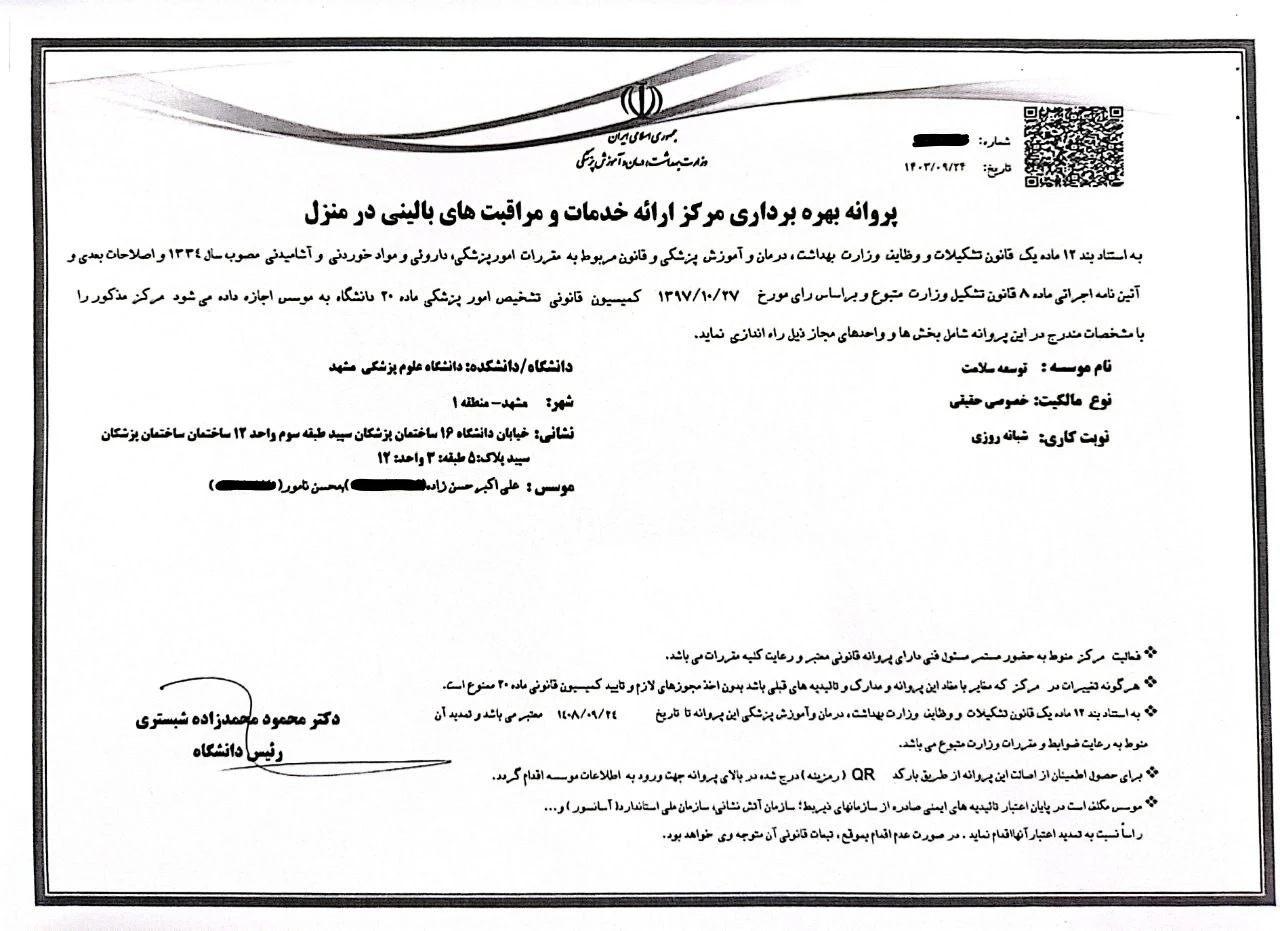
If a doctor has requested a home X-ray for you or a family member and you cannot get to an imaging centre, the Tose Salamat home clinical care centre provides X-rays at home in Mashhad with standard portable equipment and an experienced team. For more information or to book, call +98 930 900 9159.