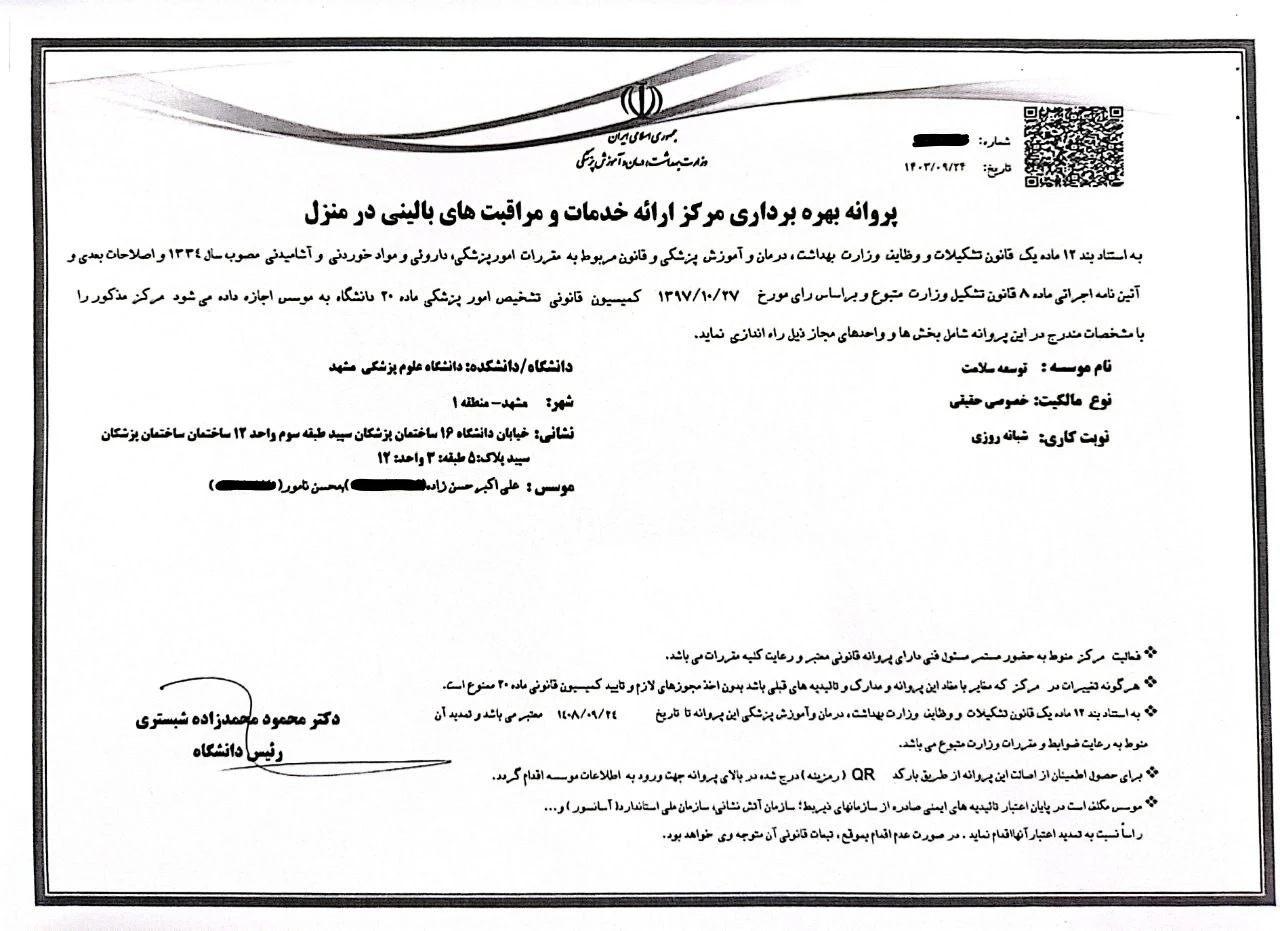

Description
ENT specialist day and night in Mashhad: home visits
If you need an ear, nose and throat (ENT) specialist at night or on a holiday and getting to a clinic is difficult for the patient, Tose Salamat sends an ENT specialist to your home in Mashhad, day and night. The examination is done with an otoscope and portable equipment, and a prescription is issued if needed.
Problems that can usually be assessed and treated at home:
- Earache and middle or outer ear infections
- Earwax and blocked ears; ear washing or suction
- Sinusitis, blocked nose and allergies
- Sore throat and tonsillitis
- Dizziness and imbalance that make it hard for the patient to travel
- Mild, recurrent nosebleeds in older people
When should you go to the emergency department or call an ambulance (115 in Iran) instead of booking a home visit? Shortness of breath or a noisy, rasping sound when breathing; being unable to swallow saliva; rapid swelling of the neck or under the tongue; a severe nosebleed that does not stop after 15 minutes of continuous pressure; sudden facial paralysis; or a foreign object stuck in the airway. Sudden hearing loss in one ear is also urgent and should be checked by a specialist as soon as possible, ideally the same day.
An ENT specialist at home in Mashhad and their vital role in diagnosing and treating ENT diseases
Otolaryngology (ENT) is the branch of medicine that diagnoses and treats diseases of the ear, nose, paranasal sinuses, pharynx and larynx, salivary glands and many other head and neck conditions.
This specialty matters because the vital pathways for breathing, swallowing and speech, and key senses such as hearing and balance, are all in this area. An ENT specialist at home — especially in a city like Mashhad — is a very valuable and sometimes decisive service for patients who cannot get to a clinic because of fever, weakness, dizziness, severe pain, old age, limited mobility, breathing problems or a high risk of infection.
An ENT assessment at home is not just a “simple visit”. It can include careful examination of the ear and eardrum, assessment of acute or chronic sinus infection, checking nasal blockage and bleeding, assessing purulent sore throats, voice problems and hoarseness, dizziness of vestibular origin, and ruling out dangerous conditions such as deep neck abscesses or ear infections at risk of intracranial complications.
This article describes the services, diagnostic approaches, treatment protocols and emergencies related to an ENT specialist at home in Mashhad.
Specialist ENT examination at home: what is assessed
A standard ENT examination is based on a careful history, related symptoms, a targeted examination and, if needed, referral for imaging or tests. At home, too, an accurate clinical assessment is possible when proper principles are followed.
Systematic history taking and identifying red flags
The ENT specialist usually asks the patient or family about:
- How the symptoms started (acute, subacute or chronic) and their course (improving or getting worse)
- Fever, chills, severe weakness, unexplained weight loss
- Ear or facial pain, ear discharge, hearing loss, ringing in the ears (tinnitus)
- Spinning dizziness (vertigo) or imbalance, nausea and vomiting
- One-sided nasal blockage, purulent discharge, bad breath, reduced sense of smell (hyposmia/anosmia)
- Nosebleeds (epistaxis) and use of anticoagulant medicines
- Sore throat, painful swallowing (odynophagia), difficulty swallowing (dysphagia), hoarseness
- Shortness of breath, noisy breathing, sleep apnoea, heavy snoring
- History of allergy, asthma, reflux (GERD/LPR), previous surgery, contact with an infectious patient
Examination of the ear, nose, throat and neck at home
The clinical examination focuses on:
- Outer ear and ear canal: inflammation, earwax (cerumen), foreign bodies, eczema
- Eardrum: colour, bulging, perforation, fluid behind the drum (otitis media with effusion)
- Nose and sinuses: septal deviation, polyps, swollen turbinates, discharge
- Throat and tonsils: exudate, abscess, enlarged tonsils, signs of streptococcal infection
- Larynx and voice: pattern of hoarseness and warning signs
- Neck lymph nodes: enlargement, tenderness, hardness, fixation
- Brief neurological examination for dizziness: nystagmus and balance tests
The most common reasons to call an ENT specialist at home in Mashhad
Middle and outer ear infections (otitis media / otitis externa)
Ear infection is one of the most common causes of severe earache in children and adults. Otitis externa usually causes pain when the earlobe is pulled or the tragus is pressed, along with itching and discharge, and is more common in swimmers. Otitis media often follows a respiratory infection and causes fever, earache, reduced hearing and sometimes discharge if the eardrum perforates. The ENT specialist at home distinguishes the type of infection and provides precise treatment (ear drops, or systemic antibiotics when indicated) and care advice.
Earwax, blocked ear canal and sudden or gradual hearing loss
A canal blocked by impacted wax can cause a feeling of fullness, conductive hearing loss and even mild dizziness; it is more common in older people and hearing-aid users. Sudden sensorineural hearing loss, on the other hand, is an ENT emergency that needs fast action. If it is suspected, the ENT specialist at home starts urgent referral and standard treatment.
Acute and chronic sinusitis (rhinosinusitis)
Acute sinusitis usually causes facial pain or pressure, nasal blockage, purulent discharge, a reduced sense of smell and sometimes fever. The specialist distinguishes viral from bacterial sinusitis and adjusts treatment according to the severity and duration of symptoms, high fever, severe one-sided pain or a “double worsening”. In chronic sinusitis, the role of allergy, nasal polyps, septal deviation and reflux is assessed.
Allergic rhinitis and chronic nasal congestion
Allergic rhinitis causes repeated sneezing, a clear runny nose, itchy eyes and nose and intermittent blockage. Proper treatment includes avoiding triggers (dust, mites, smoke, perfumes), saline nasal rinses and standard medicines when indicated. At home, the ENT specialist can look at the home environment and give practical advice on reducing allergens.
Purulent sore throat, tonsillitis and peritonsillar abscess
A severe sore throat with fever, painful swallowing, enlarged neck glands and white patches on the tonsils may be caused by streptococcal infection; correct diagnosis matters to prevent complications such as rheumatic fever. A peritonsillar abscess — suggested by a displaced uvula, trismus (being unable to open the mouth), drooling and a “hot potato” voice — is an emergency that needs immediate referral.
Hoarseness and disorders of the larynx
Hoarseness lasting more than 2 to 3 weeks needs specialist assessment. Causes include laryngitis, laryngopharyngeal reflux (LPR), voice misuse, vocal cord nodules or polyps and, sometimes, more serious lesions. The ENT specialist reviews risk factors (smoking, occupation, reflux), gives initial treatment and arranges further tests if needed.
Dizziness and balance disorders (vertigo)
True vertigo (a spinning sensation) can have peripheral vestibular causes such as benign paroxysmal positional vertigo (BPPV), vestibular neuritis or Ménière’s disease, or central causes. By examining nystagmus, how symptoms change with position and any associated neurological signs, the specialist decides on treatment and referral. In BPPV, standard repositioning manoeuvres can be performed when appropriate.
What an ENT specialist can do at home, and what usually needs a clinic
Common services at home (depending on equipment and the patient’s condition)
- Full ENT visit and examination
- Monitoring and adjusting treatment for infections and allergies
- Assessment and first management of nosebleeds, with care advice
- Specialist advice on reflux and its effects on the throat and larynx
- Assessment of snoring and sleep apnoea and referral for a sleep study
- Initial assessment of hearing loss and tinnitus and whether audiometry is needed
- Assessment of dizziness and whether a manoeuvre or imaging is needed
Situations that usually need referral to a clinic or hospital
- Sudden hearing loss (needs urgent action and specialist tests)
- Severe or recurrent nosebleeds, especially in patients taking warfarin or DOACs
- Suspected peritonsillar or deep neck abscess
- Shortness of breath, stridor or signs of airway obstruction
- Suspected mastoiditis, complicated ear infections or intracranial complications
- A hard, persistent neck lump, or blood in saliva or sputum with warning signs
- The need for nasal or laryngeal endoscopy or other specialist invasive procedures
ENT red flags that need emergency care
- Shortness of breath, wheezing or stridor, blue lips or reduced consciousness
- High fever with a stiff neck, severe headache and sensitivity to light
- Dizziness with neurological signs (one-sided weakness, slurred speech, double vision)
- A nosebleed that cannot be controlled, or with low blood pressure or severe weakness
- Severe earache with swelling behind the ear, a pushed-out earlobe or high fever
- Severe sore throat with inability to swallow, drooling, trismus or a displaced uvula
- Sudden hearing loss in one ear
Why an ENT home visit helps high-risk patients in Mashhad
For older people, patients with heart or lung disease, people with limited mobility, immunocompromised patients, patients after surgery, children with fever and severe restlessness, and people for whom cross-infection is a concern, a home visit allows:
- Faster diagnosis without waiting
- Lower risk of passing on infection
- Regular treatment and follow-up in a safe environment
- Coordination with nursing, internal medicine, occupational therapy and physiotherapy when needed
Tose Salamat home clinical care centre, Mashhad
With a network of experienced, dedicated ENT doctors, Tose Salamat in Mashhad is ready to send an ENT specialist to your home to assess, diagnose and treat disorders of the ear, nose, sinuses, throat and larynx. Our approach is based on clinical standards, safety, evidence-based decisions and attention to each patient’s situation at home, so treatment is accurate, fast and low-stress for the family.
To arrange an ENT specialist home visit in Mashhad, call +98 930 900 9159.
Frequently asked questions about an ENT specialist at home
Will an ENT specialist come to my home in Mashhad day and night?
Yes. Tose Salamat’s ENT specialist visits homes in Mashhad day and night, including holidays. To arrange a visit, call +98 930 900 9159.
Can ear washing and suction be done at home?
Yes, when needed. The specialist first examines the ear with an otoscope; if the eardrum is perforated or there is an active infection, washing is not done and another suitable method is chosen.
Does the ENT doctor bring the equipment needed for a thorough examination?
Yes. Our specialists bring portable diagnostic equipment (such as an advanced otoscope to examine the eardrum) and the tools needed for ear suction and washing, so the examination is just like one in a clinic.
When should we request an ENT specialist at home?
For example for severe dizziness that stops the patient from moving (such as Ménière’s disease), acute middle ear infection and pain, recurrent nosebleeds in older people, or examining restless children who are afraid of clinics.
When should we go to the emergency department instead of booking a home visit?
If there is shortness of breath or noisy breathing, inability to swallow saliva, rapid neck swelling, a severe nosebleed that does not stop after 15 minutes of pressure, or sudden facial paralysis, go to the emergency department immediately or call 115.