Description
Speech therapy at home in Mashhad: specialist rehabilitation of speech, language, swallowing and voice in the safety of home
Speech therapy (speech-language pathology) is a specialist branch of rehabilitation that assesses and treats disorders of speech, language, communication, voice and swallowing. Many people need regular, long-term sessions because of stroke, Parkinson’s disease, traumatic brain injury (TBI), developmental disorders in children, learning difficulties, stuttering, cleft palate, or swallowing problems after a hospital stay.
Repeated trips to a clinic in a city like Mashhad — especially for older people, patients with limited mobility, or children who become anxious in busy places — can slow treatment down or even stop it. That is why speech therapy at home in Mashhad, given by an experienced therapist, is an effective, safe and practical option that puts the exercises into the patient’s real daily life.
Who is home speech therapy for?
Speech therapy is not only about “talking”; it covers a wide range of problems:
- Stroke (CVA) and aphasia: difficulty expressing or understanding language, naming objects, reading and writing
- Dysarthria and apraxia of speech: problems controlling the speech muscles or planning speech movements
- Parkinson’s disease and movement disorders: quiet voice, monotone speech, slow or unclear speech
- Traumatic brain injury (TBI) and cognitive-communication problems: weak attention, working memory, organising speech and problem-solving in conversation
- Children with speech and language delay: late talking, small vocabulary, weak sentence building
- Autism spectrum disorder (ASD): social communication skills, starting conversations, turn-taking, understanding gestures
- Stuttering: repetitions, prolongations, blocks and speech anxiety
- Articulation and phonological disorders: substituting or leaving out sounds, unclear speech
- Voice disorders: chronic hoarseness, nodules or polyps, vocal strain and voice misuse
- Cleft palate and hypernasality: air escaping through the nose, abnormal resonance, compensatory articulation patterns
- Swallowing disorders (dysphagia): coughing while eating or drinking, food getting stuck, food coming back up, weight loss, aspiration pneumonia
- Patients after intubation or tracheostomy: retraining voice and swallowing, and alternative communication
Advantages of home speech therapy over clinic visits
The closer speech therapy is to “real life”, the better skills carry over into everyday living. Treatment at home has these key advantages:
- Practice in real situations: conversation practice in the kitchen and living room, on the phone, while shopping and with family members
- Less fatigue and stress for the patient: especially after stroke, in Parkinson’s disease, heart and lung disease, and for older people
- More family involvement: carers are taught directly how to practise between sessions and how to adjust the way they communicate
- Safer care of swallowing disorders: sitting position, cups and utensils, eating speed and the mealtime environment are checked and corrected on the spot
- Better adherence to treatment: no traffic, travel costs or waiting rooms
How the first home assessment works
The first session is a thorough assessment, so that treatment is based on real needs:
- Full history: when the problem began, how it has progressed, medicines, history of stroke, surgery or neurological disease
- Language assessment (expression and comprehension): naming, repetition, fluency, multi-step instructions
- Motor speech assessment: rate, clarity, coordination of breathing and speech, strength and range of tongue and lip movement
- Voice assessment: voice quality, hoarseness, loudness and pitch, breathing pattern
- Functional communication: everyday conversation, phone calls, expressing needs
- Cognitive-communication assessment: attention, memory, planning, cognitive flexibility in conversation
- Swallowing assessment (screening and clinical assessment): mouth and teeth, saliva control, and swallowing liquids, purées and solids where it is safe to test
Speech therapy after stroke, at home in Mashhad
After a stroke, three areas are commonly affected: language (aphasia), speech (dysarthria or apraxia) and swallowing (dysphagia). At home, the therapist can combine targeted exercises with real-life tasks:
- Improving naming and word retrieval with graded exercises
- Strengthening listening comprehension with real instructions (for example fetching an object or following the steps of a task)
- Treating apraxia by repeating mouth-movement patterns with visual and touch cues
- Improving speech clarity by practising slower speech, rhythm and stress (prosody)
- For swallowing problems: teaching correct sitting posture, bite size, eating speed and safe swallowing manoeuvres
Speech therapy for Parkinson’s disease: managing voice and clarity at home
Parkinson’s disease often brings a quieter voice, monotone speech, reduced mouth movements and rushed speech. Home treatment can include:
- Exercises to increase loudness, monitored with auditory feedback
- Strengthening diaphragmatic breathing for longer phrases
- Practising clarity on key words and purposeful pauses
- Teaching the family how to ask the patient to “say it again, louder” in a helpful way, without creating tension
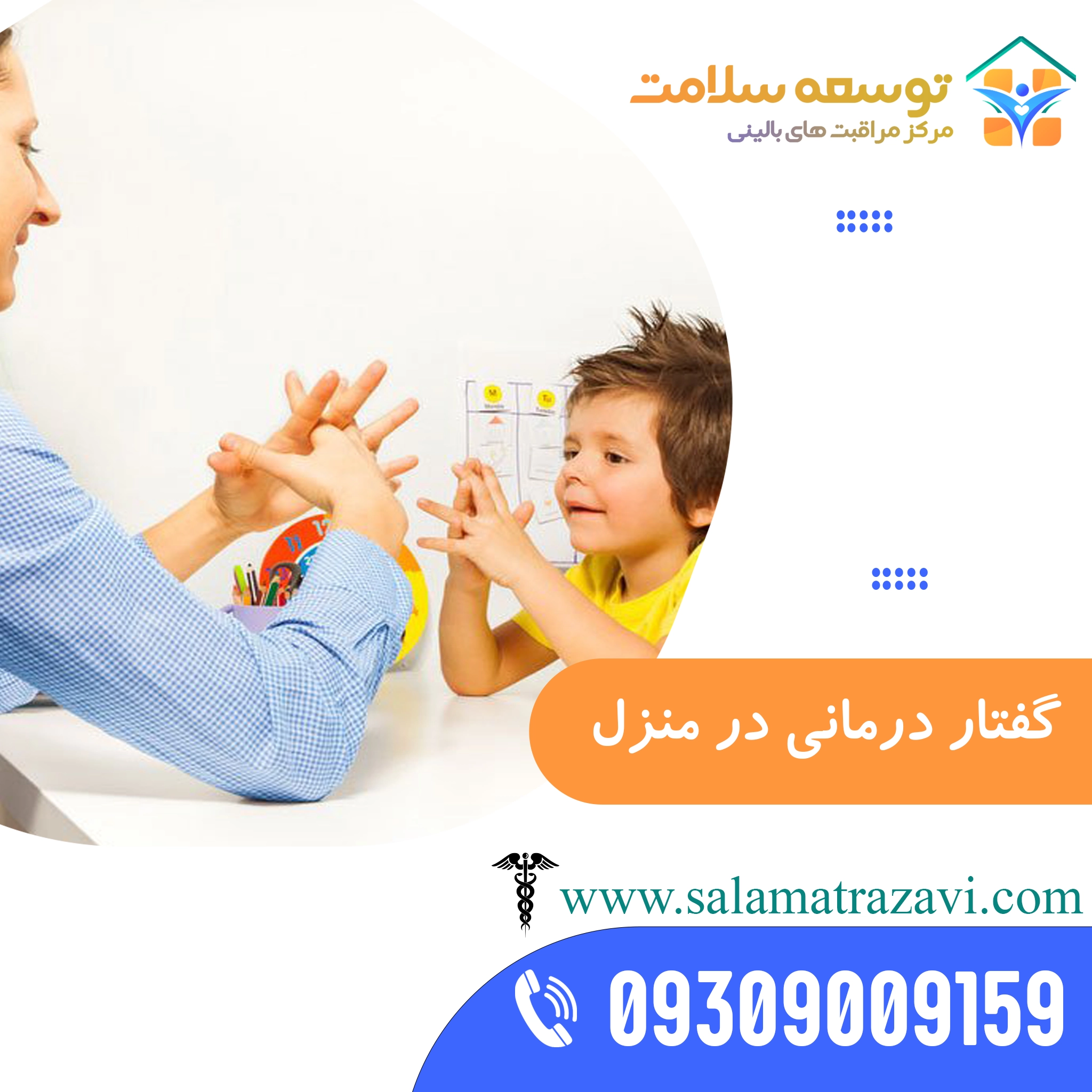
Children’s speech therapy at home in Mashhad: speech delay, articulation, stuttering and social skills
For children, play, real interaction and parents’ involvement are vital. At home, the therapist can use the same toys and situations the child deals with every day:
- Language delay: building vocabulary, sentence formation, following instructions, question-and-answer skills
- Articulation disorders: correcting sound production step by step, from syllables to sentences and conversation
- Stuttering: fluency techniques, reducing pressure, improving parent–child interaction and managing speech anxiety
- Social communication in ASD: turn-taking, functional eye contact, starting conversations, making requests, coping with hearing “no”
Treating swallowing disorders at home: lowering the risk of aspiration and pneumonia
A swallowing disorder is potentially dangerous: food or liquid can enter the airway (aspiration) and cause a lung infection. At home, the speech therapist focuses especially on safe eating:
- Teaching correct body position and head and neck angle while eating
- Choosing the right food texture (thickened liquids, purée, soft food) according to what the patient tolerates
- Exercises to strengthen the mouth and throat muscles where appropriate
- Teaching warning signs: coughing while eating, a change in voice after swallowing, tiring during meals, repeated fevers
- Working with the doctor, nurse and, if needed, an occupational therapist to manage rehabilitation as a whole
The family’s role in successful home speech therapy
Without practice between sessions, progress slows down. In every session the therapist teaches the family:
- How to talk with the patient or child so that communication pressure is low but practice stays effective
- How to do short, achievable and measurable home exercises
- Which mistakes hold treatment back (such as constant correcting, interrupting or hurrying)
- How to record progress (a practice notebook, short voice recordings, a daily checklist)
Number of sessions and length of home speech therapy
How long treatment takes depends on the underlying cause, the severity of the disorder, age, cooperation and how consistently exercises are done. Typically:
- Each session lasts 45 to 60 minutes
- 1 to 3 sessions a week, depending on clinical need
- After a stroke and for swallowing disorders, sessions may be more frequent in the first weeks
The treatment plan is set after the first assessment and adjusted along the way according to the patient’s response.
Frequently asked questions about home speech therapy in Mashhad
Is home speech therapy as effective as therapy in a clinic?
In many cases it is even more effective, because exercises are done in a real environment and the family takes part. The most important factors are the therapist’s expertise and keeping up the exercises between sessions.
Is speech therapy only for children?
No. A large share of speech therapy patients are adults, especially after stroke, with Parkinson’s disease, after brain injury and with swallowing problems.
How do we know if a child needs speech therapy?
If a child has no meaningful words by 18 months, is not using two-word sentences by age 2, or is hard for others to understand, a speech therapy assessment is recommended. Any parental concern about social communication or stuttering also deserves an assessment.
When is a swallowing problem an emergency?
If the patient has severe coughing, a change in voice, shortness of breath, turns blue, or has repeated fevers when drinking, they need a specialist assessment quickly — and with severe symptoms, emergency care is essential.
Do we need a doctor’s prescription to start home speech therapy?
No. However, if the patient has a history of stroke, surgery or neurological disease, or previous reports, sharing the medical records helps the therapist design a more precise plan.
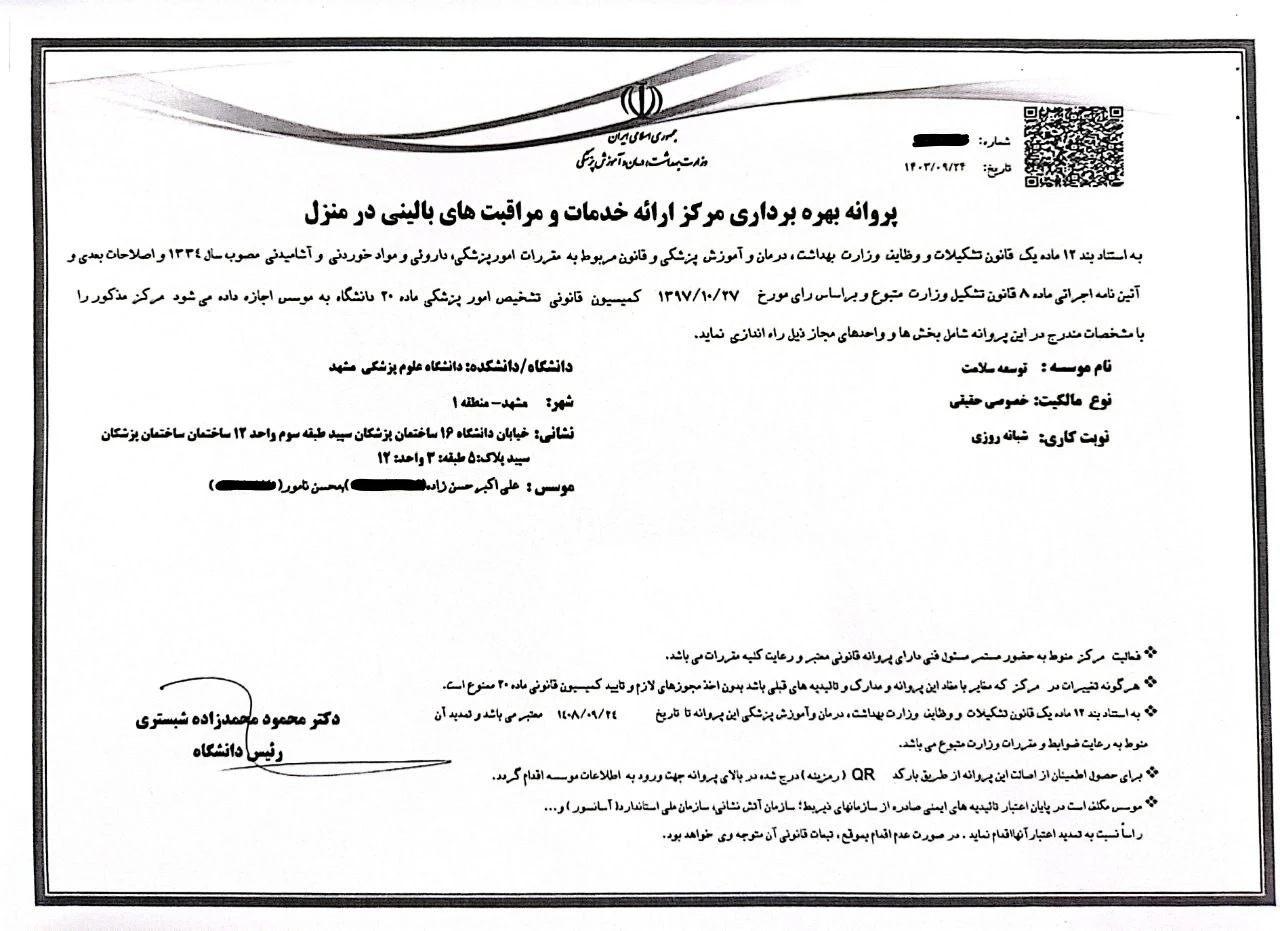
Tose Salamat home clinical care centre, Mashhad
Tose Salamat home clinical care centre in Mashhad works with experienced speech therapists and current scientific approaches to assess and treat disorders of speech, language, voice, communication and swallowing at home, in every area of Mashhad. Our aim is for rehabilitation to happen in the safety of home, with as little stress and as much benefit as possible, and for families to learn practical ways to keep up the exercises between sessions.
To arrange home speech therapy in Mashhad or for specialist advice, call +98 930 900 9159.