
Description
Why kidney and urinary tract specialist care at home matters in Mashhad
Diseases of the kidneys and urinary tract, the fields of urology and nephrology, account for a large share of health problems, especially in older people, people with chronic illness and patients with limited mobility. The kidneys are the body’s vital filters: they clean the blood, balance electrolytes, help control blood pressure and produce important hormones.
Any disturbance in how these organs work, or in the outflow of urine, can quickly lead to a build-up of toxins in the body and serious clinical complications. Taking patients with acute or chronic urinary problems to busy clinics and surgeries in Mashhad brings many difficulties.
City traffic, long waits, the risk of drug-resistant hospital infections and the difficulty of moving frail patients make access to bedside urology and nephrology care all the more important. A kidney and urinary tract specialist visiting at home in Mashhad allows the patient to have a thorough physical examination, diagnostic tests and specialist treatment in a calm, safe setting, so that recovery is faster and better.
Anatomy and function of the urinary system, and how common disorders develop
The urinary system consists of two kidneys, two ureters, the bladder and the urethra. The kidneys lie behind the abdominal lining (retroperitoneum), and their working unit, the nephron, filters the plasma, reabsorbs useful substances and excretes nitrogen-containing wastes such as urea and creatinine. Urine passes down the ureters to the bladder, where it is stored until it is passed. Each part of the system can be affected in its own way.
Acute kidney injury is a sudden fall in glomerular filtration. Its causes can be pre-renal (such as severe dehydration and reduced blood flow), renal (damage to kidney tissue from medicines or infection) or post-renal (blockage of the urinary tract). Chronic kidney disease is a gradual, destructive process, most often caused by poorly controlled diabetes and high blood pressure, that leads to a permanent loss of nephron function.
Kidney and urinary stones form when minerals such as calcium oxalate crystallise in concentrated urine, and their passage down the ureter causes pain as severe as labour pain and can block the flow of urine. Lower down the system, benign enlargement of the prostate in older men squeezes the urethra, stops the bladder emptying fully and makes repeated infections and acute urinary retention more likely.
Who benefits most from bedside urology and nephrology care
Specialist kidney and urinary care at home is a priority for patients for whom travel is risky or very difficult. Older people are the first group: with age, kidney mass and glomerular filtration rate fall, while urinary incontinence, prostate enlargement and atypical urinary infections become more common.
The second group is neurological patients with multiple sclerosis, Parkinson’s disease, spinal cord injury or stroke, whose disturbed nerve signalling causes a neurogenic bladder; they need regular monitoring, intermittent or permanent catheterisation and management of residual urine. The third group is patients with advanced chronic illness, such as severe heart failure, advanced diabetes or dialysis, whose large swings in fluid and electrolytes need regular assessment by a doctor at home.
The fourth group is patients who have recently had major urological surgery, such as invasive stone procedures, prostatectomy or reconstructive surgery of the urinary tract, and who are recovering at home with urinary tubes or drains.
Clinical assessment and specialist examination at home
A home visit by a kidney and urinary tract specialist starts with a detailed history from the patient or carers. The doctor asks about changes in urine volume, frequency, burning on passing urine, difficulty or stopping of the flow, changes in the colour or smell of urine, fever and chills, and pain in the side or lower abdomen.
A systematic physical examination follows. Vital signs, especially blood pressure, are checked, and the patient’s hydration is assessed from skin turgor and swelling of the legs. When examining the abdomen and sides, the doctor checks for tenderness at the costovertebral angle; pain there on gentle tapping is a classic sign of kidney infection (pyelonephritis) or a blockage caused by a stone.
The area above the pubic bone is felt for a distended bladder caused by acute urinary retention, which is a urological emergency. Where clinically needed and with the patient’s consent, the specialist may also examine the prostate by digital rectal examination to assess its size, consistency and any tenderness or suspicious lumps, so that the right treatment can be chosen.
Portable diagnostic and treatment equipment at the bedside
Portable technology at the bedside has greatly increased the diagnostic accuracy of kidney and urinary specialist visits at home in Mashhad. Portable ultrasound allows the doctor to check the kidneys immediately for hydronephrosis (swelling from a blockage), stones, cysts or masses.
The volume of urine left in the bladder straight after the patient passes urine is measured by ultrasound or a bladder scanner to diagnose urinary retention accurately. Rapid urine test kits are used at the bedside to detect blood, protein, nitrites and white blood cells, which point to infection or kidney damage.
For treatment, sterile catheter kits, including Foley, silicone and suprapubic catheters, special catheters and bladder irrigation equipment, are used at the bedside so that procedures can be done without delay and under fully aseptic conditions.
Urological and kidney warning signs that need urgent attention
Recognising danger signs in the urinary system is vital to prevent irreversible kidney damage and septic shock. Anuria, a complete stop in urine production for several hours, points to acute kidney injury or complete blockage of the urinary tract and needs urgent treatment.
Acute urinary retention, an inability to pass urine with severe lower abdominal pain and restlessness, needs emergency catheterisation. Haematuria, visible blood in the urine, especially if painless, can be a sign of urinary tract cancer, large stones or severe infection and should be assessed promptly. High fever and chills with pain in the side, nausea and vomiting suggest acute pyelonephritis (upper urinary tract infection), which can progress to sepsis.
Confusion, severe drowsiness and breathlessness in patients with kidney failure, signs of uraemia (build-up of toxins), need an urgent specialist visit and possibly arrangements for emergency dialysis.
Managing urinary tract infections at home
Urinary tract infections are among the most common reasons for seeing a doctor and range from cystitis (bladder infection) to pyelonephritis (kidney infection).
Managing them at home requires accurate identification of the organism through urine culture and antibiotic sensitivity testing. The kidney specialist assesses the patient and starts suitable antibiotic treatment. For simple lower urinary infections, oral antibiotics are enough; for complicated infections or mild to moderate pyelonephritis in stable patients, intravenous antibiotics can be given at home by the nursing team under the specialist’s supervision.
Monitoring the response to treatment, controlling fever, keeping the patient well hydrated with oral fluids or IV fluids, and watching for side effects are key principles of bedside management. In patients with a urinary catheter, replacing the infected catheter and good catheter hygiene are essential to clear catheter-related infection.
Assessing, preventing and treating kidney and urinary stones
Urinary stones cause very severe, stabbing pain in the side that spreads to the groin. Managing a kidney stone at home has two phases: relieving acute symptoms and helping the stone pass.
Severe pain is controlled with injected or suppository non-steroidal anti-inflammatory drugs and other suitable painkillers. To help stones in the lower ureter pass, the specialist may prescribe an alpha-blocker such as tamsulosin, which relaxes the smooth muscle of the ureter.
Advice to drink plenty of fluids is given only once the acute pain has been relieved. The specialist uses portable ultrasound to follow the size and position of the stone; if it is too large to pass on its own, or is causing severe blockage and hydronephrosis, transfer to a treatment centre is arranged for shock-wave lithotripsy or endoscopic surgery. After the stone has passed, its composition is analysed and specific diet and medicine plans are made to prevent new stones.
Managing acute and chronic kidney failure at the bedside
Kidney failure requires careful monitoring and sensitive clinical decisions. In acute kidney injury, the specialist at home first looks for and treats the underlying cause: correcting dehydration with carefully calculated IV fluids, stopping medicines that harm the kidneys and relieving any blockage of the urinary tract are the first steps.
In chronic kidney disease, the main aim is to slow progression towards end-stage kidney failure. This is done by careful control of blood pressure with kidney-protective medicines, control of blood sugar in diabetic patients, correction of anaemia caused by reduced erythropoietin, and management of calcium and phosphate disturbances.
By reviewing regular blood tests, including urea, creatinine, potassium and sodium, the nephrologist at home adjusts medicine doses and the amount of fluid the patient may drink, to prevent dangerous complications such as high potassium, which can cause cardiac arrest, or fluid building up in the lungs.
Diagnosing and managing benign prostate enlargement at home
Benign prostate enlargement is the most common urological condition in men over fifty. Symptoms include a weak urine stream, delay in starting, getting up at night to pass urine and a feeling that the bladder has not emptied fully.
The urinary specialist at home assesses the severity of symptoms with standard clinical questionnaires, a physical examination and portable ultrasound, and then starts treatment. This usually includes medicines that relax the urethra, such as tamsulosin, for quick improvement of flow, and medicines that shrink the prostate, such as finasteride, for medium- and long-term treatment. Monitoring side effects such as a drop in blood pressure on standing, and periodic PSA (prostate-specific antigen) tests to screen for cancer, are part of the specialist’s role at home.
If urine is completely retained, the doctor inserts or replaces a urinary catheter to relieve the blockage.
Neurogenic bladder and specialist catheter care at home
Patients with spinal cord injury, stroke or multiple sclerosis often develop a bladder that does not contract normally, known as a neurogenic bladder. They may have urinary retention, overflow incontinence or severe bladder spasms. Management includes medicines that relax the bladder muscle, teaching clean intermittent self-catheterisation to the patient or carer, or placing an indwelling Foley catheter.
Specialist catheter care at home is very important to prevent infection and injury to the urethra. Regular catheter changes under fully sterile conditions, checking that the tube is open and not kinked, emptying the urine bag on time and washing out the bladder if there is sediment or clots are carried out by an experienced nurse under the kidney specialist’s supervision to prevent urosepsis.
Diet and medicine plans for kidney patients
In kidney failure, clinical nutrition works like a medicine. Because urinary toxins and electrolytes build up, the diet must be carefully limited and adjusted. Key principles include reducing salt to control blood pressure and swelling, limiting potassium by avoiding too much banana, orange and tomato to prevent heart rhythm problems, and controlling phosphate by limiting dairy products and processed foods.
Daily protein intake must be set so that it reduces the workload on the kidneys without causing malnutrition and muscle wasting. Working with a dietitian, the kidney specialist at home draws up a meal plan based on the patient’s glomerular filtration rate and adjusts medicines so that they are as gentle on the kidneys as possible.
Checking drug interactions and nephrotoxicity at the bedside
Many common medicines can damage kidney tissue, a problem known as nephrotoxicity. Everyday painkillers such as ibuprofen, diclofenac and naproxen, if taken regularly without supervision, can greatly reduce kidney filtration and lead to acute or chronic kidney failure. Some antibiotics such as aminoglycosides, certain blood pressure medicines during dehydration, and contrast agents used in imaging are other nephrotoxic factors. The kidney specialist at home reviews all the patient’s medicines, adjusts doses to the patient’s creatinine clearance, stops harmful medicines and prevents drug-induced kidney damage.
Why a team approach matters in urology and nephrology care at home
Successful treatment of kidney and urinary disease at home needs a well-coordinated team. The kidney and urinary specialist, as the responsible doctor, sets the diagnostic and treatment plan. An experienced clinical nurse is the hands of the treatment: sterile catheterisation, blood and urine sampling for regular tests, intravenous antibiotics and fluids, and teaching the family about catheter care. A dietitian provides low-potassium, low-sodium meal plans, and an occupational therapist helps the patient become more independent in reaching the toilet and managing incontinence, completing the chain of care so the patient gets the best possible result.
Practical and emotional benefits of a urology home visit
A specialist home visit greatly reduces the hidden costs of moving frail patients by private ambulance, waiting in traffic and unnecessary emergency admissions. Emotionally, because urinary problems are sensitive and private, patients often feel embarrassed or anxious in busy public settings. Examination and treatment in the privacy of the home preserve the patient’s dignity, reduce stress and strengthen their cooperation with the medical team for a faster recovery.
Important care tips for families at home
Families should keep a daily eye on how much the patient drinks and how much urine they pass. Any sudden fall in urine, urine turning dark like strong tea or bloody, fever, chills, restlessness, severe burning or leakage around the catheter should be noted and reported to the doctor. The urine bag should always be kept below the level of the bladder to stop infected urine flowing back. Taking kidney medicines at the right dose and time, and not giving painkillers without checking with the doctor, are other vital principles.
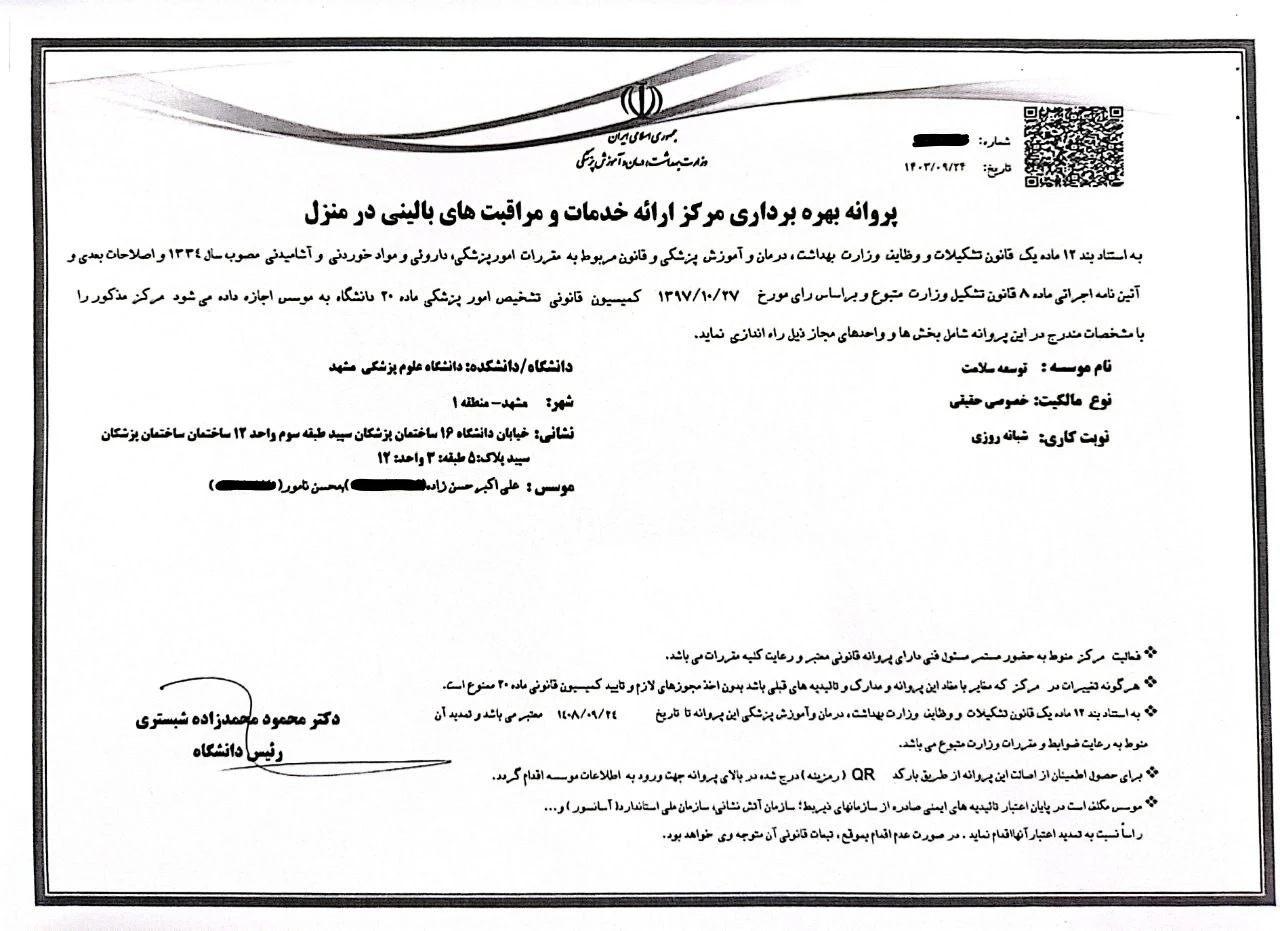
Specialist services of Tose Salamat clinical care centre
Tose Salamat clinical care centre in Mashhad, with experienced kidney and urinary specialists, skilled nurses and portable ultrasound and bladder scanning equipment, is ready to provide high-quality care in your home. Following full hygiene protocols, our specialist teams provide doctor visits, clinical tests, changes of all types of urinary catheter, bladder washouts and monitoring of kidney failure at home.
For specialist advice and to arrange a prompt home visit by a kidney and urinary tract specialist anywhere in Mashhad, call us day or night.
Phone: +98 930 900 9159
Frequently asked questions
What is the difference between a urologist and a nephrologist (kidney specialist)?
A urologist deals mainly with surgical problems, kidney stones and the prostate, while a nephrologist (kidney and blood pressure specialist) treats internal kidney diseases with medicines, such as chronic kidney disease (CKD), protein loss in the urine, medicine adjustment for dialysis patients and resistant high blood pressure.
Can a nephrologist at home order creatinine and other blood tests?
Yes. After the clinical examination, the kidney specialist can order regular kidney function tests (urea/BUN and creatinine) if needed, and you can use our centre’s home laboratory sampling service to have them done.