
Description
IV therapy at home in Mashhad: a treatment that should be used wisely
IV fluid therapy is one of the most common treatments in medicine. Every year millions of patients around the world receive it to treat illnesses, correct dehydration or receive certain medicines.
However, contrary to what many people think, an IV drip is not a tonic or an energy booster. It should only be given when a doctor considers it necessary or the patient’s condition requires it. An IV drip given without a reason does no good and, in some patients, can cause problems such as fluid overload.
For patients who cannot get to a clinic or hospital, IV therapy at home can be a good option — provided it is given by a trained nurse, with standard equipment and according to a doctor’s prescription.
In this article we explain in plain language, based on scientific principles, what IV therapy is, what it is used for, who needs it and when it should not be used.
What is IV therapy?
IV therapy, or intravenous fluid therapy, is a method in which sterile fluids are given directly into the bloodstream through a vein.
These fluids may be prescribed for different purposes, including:
- Correcting dehydration
- Correcting electrolyte imbalances
- Delivering certain medicines
- Providing fluids for patients who cannot drink enough
- Supporting the patient in certain medical conditions
The type of fluid, the volume, the drip rate and the length of treatment should all be decided by a doctor’s assessment.
How is an IV drip different from an injection?
Many people confuse the two.
An injection usually delivers a set dose of a medicine in a small volume.
An IV drip, by contrast, is a sterile solution that provides fluids and can also be used to carry certain medicines.
Put simply, not every injectable medicine is a drip, and not every drip contains medicine.
Who may need IV therapy?
A doctor may recommend IV therapy in various situations.
People who are dehydrated
Dehydration can be caused by:
- Diarrhoea
- Vomiting
- Fever
- Heavy sweating
- Drinking too little
If dehydration is severe or the patient cannot drink enough, the doctor may prescribe IV fluids.
Older people
Older people are sometimes more prone to dehydration because of a reduced sense of thirst, underlying illnesses or limited mobility. In this group, however, IV fluids must be prescribed carefully, because some cannot tolerate large volumes of fluid due to heart or kidney disease.
Patients being cared for at home
People confined to bed at home after surgery, a stroke, a chronic illness or other medical conditions may need IV therapy to continue their treatment.
Patients receiving intravenous medicines
Some medicines must be given slowly through an IV drip. In these cases the drip is part of the treatment and also carries the medicine.
Common types of IV fluid
The type of fluid is always chosen according to the patient’s condition.
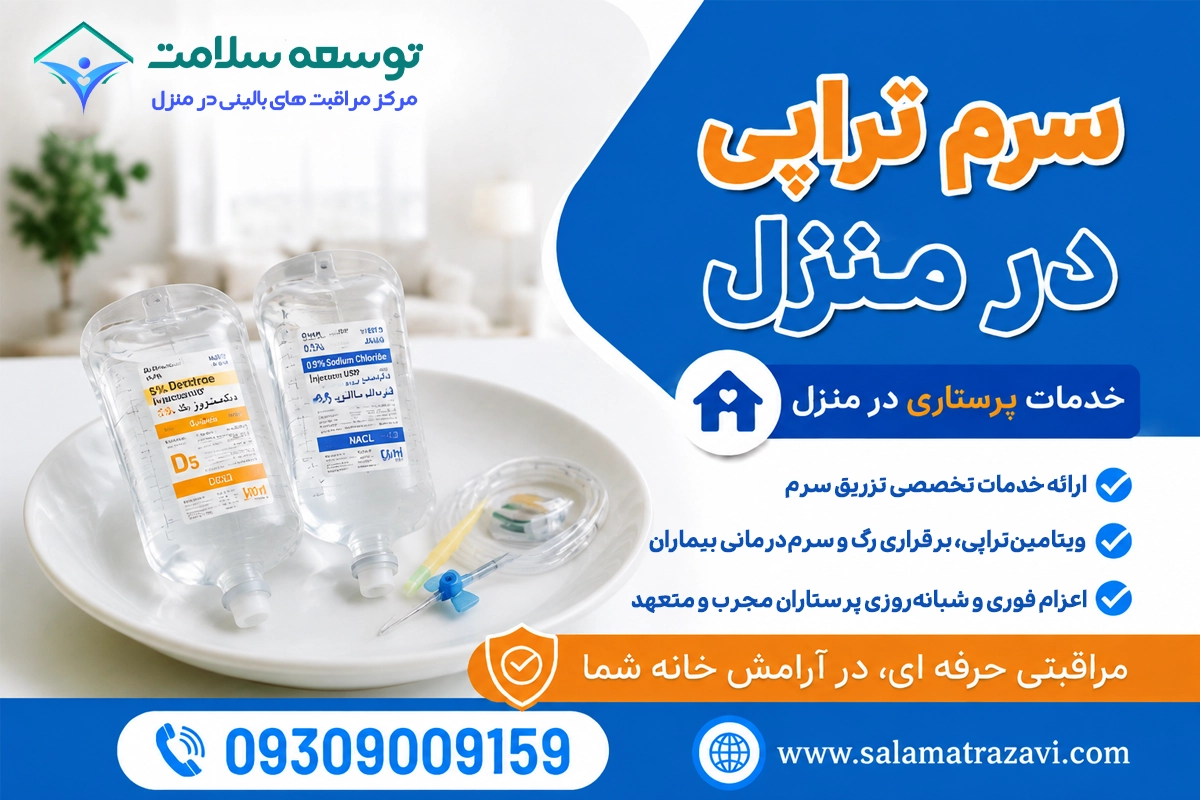
Normal saline
One of the most widely used intravenous solutions, used to replace fluids and in many hospital treatments.
Ringer’s lactate
In some situations, such as fluid loss or certain specific illnesses, the doctor may choose this solution.
Dextrose
This solution contains glucose and is used in specific situations, depending on the patient’s needs.
Other intravenous solutions
Depending on the patient’s condition, the doctor may prescribe other solutions. The choice should always be based on the clinical picture, test results and the aim of treatment.
How is IV therapy given at home?
IV therapy at home must follow infection-control principles and nursing standards.
In general, the steps are:
- Checking the doctor’s prescription
- Assessing the patient’s general condition
- Checking vital signs when needed
- Choosing a suitable vein
- Disinfecting the cannula insertion site
- Inserting the cannula using sterile technique
- Connecting the IV set
- Setting the drip rate according to the doctor’s order
- Monitoring the patient during the infusion
- Removing the cannula, or caring for it if treatment is to continue
Care after IV therapy at home
After the drip is finished, a few simple steps can lower the chance of problems and help treatment continue properly.
Check the cannula site
Mild pain or slight bruising after the cannula is removed is usually normal and settles within a few days. But if you notice redness, swelling, warmth, discharge or severe pain, tell the doctor or nurse.
Drink fluids as your doctor advises
For many patients it is important to keep drinking after IV therapy. However, people who must limit fluids because of heart or kidney disease should follow their doctor’s instructions only.
Continue prescribed medicines
IV therapy is usually one part of a treatment plan and does not replace oral medicines or other treatments, unless the doctor says otherwise.
Do not delay if warning signs appear
If after the drip you notice shortness of breath, severe swelling of the arm or leg, chest pain, fever, shivering, reduced alertness or an allergic reaction, contact emergency services or the treating doctor immediately.
Common mistakes about IV therapy
Some mistaken beliefs lead people to ask for an IV drip without real need or without consulting a doctor.
Asking for a drip for any weakness or tiredness
Not every feeling of weakness or lethargy is caused by dehydration. Sometimes the real cause is anaemia, a thyroid problem, an infection, a heart problem or something else that needs medical investigation.
Adding medicines to the drip without a prescription
Adding a medicine to an IV drip without a doctor’s prescription can be dangerous. Some medicines are not compatible with each other or with a particular fluid, which can reduce their effect or cause side effects.
Relatives changing the drip rate
The rate at which fluid enters the body should follow the doctor’s prescription. Changing it yourself can cause problems, especially in older people, children and patients with heart or kidney disease.
Repeated drips to “build up the body”
Contrary to a common belief, an IV drip does not replace a healthy diet, enough sleep or treatment of the underlying illness, and should not be used as a general tonic.
Who should receive IV fluids with extra caution?
In some patients, IV fluids require a more careful assessment, including:
- People with heart failure
- Patients with kidney failure
- Patients with uncontrolled high blood pressure
- People with severe swelling of the limbs
- Pregnant women (according to the doctor’s opinion)
- Children and infants
- Very elderly people
In these groups, the type of fluid, the volume and the drip rate must be set with extra care.
Frequently asked questions
Is IV therapy at home safe?
When it is given by a trained nurse, with sterile equipment and according to a doctor’s order, IV therapy at home is in many cases a safe and effective method.
How long does IV therapy take?
It depends on the type and volume of fluid, the patient’s condition and the rate prescribed by the doctor, and can range from under an hour to several hours.
Can I eat after IV therapy?
In most cases yes, unless the doctor has set a restriction because of a specific illness.
Does an IV drip increase energy?
If lethargy is caused by dehydration, replacing fluids can help you feel better. But an IV drip is not in itself an energy booster or a general tonic.
Does every patient with a fever need an IV drip?
No. Many people with a fever recover with oral fluids and treatment of the cause. The need for a drip should be decided by a doctor’s assessment.
Can children receive IV fluids at home?
In some situations and on a doctor’s diagnosis, yes. However, the child’s condition and the right place for treatment should be assessed and decided by a doctor.
Summary
IV therapy is an effective way to correct dehydration, fluid and electrolyte imbalances and to deliver certain medicines. However, it should only be used when there is a medical indication and on a doctor’s prescription.
IV therapy at home can be a good option for older people, patients cared for at home, people with limited mobility and patients who cannot get to a medical centre — provided it is given by an experienced nurse, with standard equipment and full infection control.
If a doctor has prescribed IV therapy for you or a family member and you cannot get to a medical centre, the Tose Salamat home clinical care centre provides IV therapy at home in Mashhad with experienced nurses and standard equipment. To arrange a visit or for more information, call +98 930 900 9159.