
Description
Injections at home in Mashhad: bringing treatment to your door
Many patients need injections, IV drips or intravenous medicines to continue treatment after hospital discharge or a doctor’s visit. In the past this usually meant going to a clinic or hospital — difficult and sometimes risky for older people, frail patients, people with limited mobility and families short of time.
Today, injections at home allow much of this treatment to happen in the safety and calm of home. An experienced nurse at home means fewer unnecessary trips, less stress for the patient, time saved and treatment that continues correctly.
However simple it may seem, an injection is a medical procedure and should only be given by trained staff following scientific principles and infection control.
In this article we explain in plain language what home injections are, what they include, who needs them, what to do before and after an injection, and how to receive this service with confidence.
What are injections at home?
Injections at home are services in which a nurse or trained clinician gives medicines prescribed by a doctor at the patient’s home, with safe and sterile technique.
They can include intramuscular, intravenous, subcutaneous and intradermal injections, IV therapy and some related care.
The main aim is to let treatment continue without repeated trips to medical centres — especially for patients for whom moving is difficult or risky.
Who needs injections at home?
Home injections are not necessary for everyone, but in some situations they are the best choice.
Older people
Many older people find trips to a clinic difficult because of osteoarthritis, osteoporosis, balance problems or chronic illness. Care at home is more comfortable and reduces the risk of falls or injury.
Patients confined to bed at home
People bedbound at home because of stroke, heart disease, cancer, advanced organ failure or other illness often need injections or IV fluids to continue treatment.
Patients after surgery
After some operations the doctor may prescribe antibiotic or anticoagulant injections or IV therapy. Having these at home helps the patient recover more calmly.
People with limited mobility
Patients with spinal cord injury, MS, Parkinson’s disease or severe fractures may not be able to leave home; injections at home are a good option for them.
Patients who need regular treatment
Some medicines must be injected at set times on a regular basis. Having these injections at home helps keep exactly to the treatment schedule.
Types of injection that can be given at home
The type of injection should always follow the doctor’s prescription and the patient’s condition. The most common services are:
Intramuscular injection (IM)
One of the most common methods. The medicine is injected into a muscle and absorbed gradually. Medicines that may be given intramuscularly include:
- Some antibiotics
- Vitamin B12
- Some anti-inflammatory medicines
- Some vaccines (as directed by the doctor)
Intravenous injection (IV)
The medicine goes directly into the bloodstream and usually acts faster. IV injections must only be given by trained staff, as they need skill in finding a vein and strict sterile technique.
IV therapy (drips)
IV therapy is one of the most common home nursing services. It may be used to correct dehydration, give certain medicines or provide fluids the patient needs. However, not everyone who feels weak or tired needs a drip; it should be prescribed after a doctor’s assessment.
Subcutaneous injection (SC)
The medicine is injected into the fatty layer under the skin. Some medicines, such as insulin or certain anticoagulants, are given this way.
Intradermal injection (ID)
Used mainly for some diagnostic tests or special medical purposes, with a very small volume of medicine.
What should be checked before an injection at home?
For safe injections, a few points are essential:
- Have the doctor’s prescription to hand.
- Check the medicine’s name, dose and expiry date.
- Mention any drug allergy before the injection.
- Tell the nurse if you take blood thinners or have specific medical conditions.
- The place where the injection is given should be clean, well lit and with enough space.
How is an injection given at home?
A common question is what happens when the nurse arrives. Knowing the process helps the patient feel calmer.
1. Checking the prescription
The first and most important step is checking the doctor’s prescription or order. The nurse checks the medicine, dose, route and timing to prevent any error. If the prescription is unclear, it is clarified before injecting. No medicine should be injected based only on what others say or past experience.
2. Assessing the patient
Before the injection, the patient’s general condition is checked. If needed, this may include blood pressure, pulse, temperature, level of consciousness, breathing and history of drug allergy. These checks help identify situations in which an injection could be risky.
3. Preparing the equipment
All equipment must be sterile and single-use, usually including:
- Sterile syringe and needle
- Disposable gloves
- Sterile gauze
- Alcohol swabs
- Plaster
- IV set (if needed)
- A sharps container
Reusing a syringe or needle is never allowed.
4. Choosing the injection site
The site depends on the type of injection. For example, intramuscular injections are usually given in the buttock, upper arm or thigh; subcutaneous injections in the abdomen, arm or thigh; and intravenous injections after choosing a suitable vein. Choosing the right site helps reduce pain and prevent complications.
5. Disinfecting the site
The skin is disinfected with a suitable solution before the injection to minimise the chance of germs entering the body.
6. Giving the injection
The nurse gives the medicine as prescribed and according to clinical principles. The speed, needle angle and technique vary with the medicine and the patient.
7. Care after the injection
Afterwards, the patient is observed for a short time for any unusual reaction, and advice on aftercare is given if needed.
Why are injections by untrained people dangerous?
Some people think giving an injection is simple and anyone can do it. This mistaken belief can have serious consequences. An incorrect injection can cause:
- Nerve damage
- Bleeding
- Infection
- Injection of the wrong medicine
- Medicine entering the wrong tissue
- Tissue necrosis
- Severe allergic reactions
- Air embolism with intravenous injections
That is why injections should only be given by trained staff following clinical principles.
Do injections hurt?
How much they hurt depends on the medicine, the volume injected, the site, the skill of the person giving it and how tense the patient’s muscles are. Correct technique can reduce pain considerably.
Care after an injection
Keep the site clean.
Avoid touching the injection site unnecessarily for the first few hours.
Don’t worry about mild pain.
Slight pain or stiffness after an intramuscular injection is usually normal and settles within a day or two.
Don’t massage the site.
Unless the doctor or nurse advises otherwise.
Tell the doctor about unusual symptoms.
Such as:
- Severe pain
- Marked swelling
- Spreading redness
- Discharge
- Fever
- Shortness of breath
- Hives
- Severe dizziness

Myths about injections
“An IV drip always makes the patient feel better.”
No. A drip is not a medicine and is not necessary for everyone. Unnecessary drips are not only useless but can be dangerous for some patients, such as those with heart or kidney failure.
“Injections are stronger than tablets.”
Not always. The route of a medicine depends on the illness, the patient and the doctor’s judgement. In many cases a tablet is just as effective as an injection.
“Every fever or cold needs an injection.”
No. Most viral infections improve with supportive care; taking antibiotics or injections without advice is not only unhelpful but can cause side effects and antibiotic resistance.
When should an injection not be given at home?
Although home injections are valuable, in some situations going to the emergency department or hospital immediately is essential, including:
- Shock or a severe drop in blood pressure
- Severe bleeding
- Reduced consciousness
- Seizure
- Severe chest pain
- Severe shortness of breath
- A severe allergic reaction to a medicine
- A need for intensive care and continuous monitoring
In these situations, delaying going to a medical centre can be dangerous; an injection at home does not replace emergency care.
Frequently asked questions about injections at home
Do we need a doctor’s prescription for injections at home?
Yes. All injectable medicines should only be used on a doctor’s prescription. The prescription helps the nurse give the right medicine, dose, route and schedule. Never inject a medicine without advice, even if you have used it before.
Can every injection be given at home?
No. Many medicines can be injected at home following clinical principles, but some need continuous monitoring, special equipment or a medical setting. If in doubt, the doctor or nurse will decide the best place for the injection.
Is IV therapy helpful for weakness or tiredness?
Not always. Weakness, lethargy or tiredness can have many causes and do not necessarily mean a drip is needed. Unnecessary drips can cause problems in some people, especially those with heart or kidney failure. The decision should be based on a medical assessment.
Is pain or stinging during an injection normal?
Mild pain or brief stinging can be normal, but if there is severe pain, marked swelling, numbness, skin discolouration or other unusual symptoms, tell the nurse or doctor promptly.
Are injections at home suitable for older people?
Yes. Older people who cannot get to medical centres because of mobility problems, chronic illness or their physical condition are among the main users of home injections. As well as fewer trips, it brings more peace of mind to the patient and family.
Can children receive injections at home?
With a doctor’s prescription and correct technique, some injections can also be given to children at home. The method and the child’s condition should be assessed by clinical staff.
Is the injection equipment replaced at every visit?
Yes. Syringes, needles and other consumables must be sterile and single-use and disposed of safely after use.
Important tips for families
If a family member needs regular injections, keep these points in mind:
- Store medicines as instructed and in suitable conditions.
- Do not keep medicines at the wrong temperature.
- Never ignore a medicine’s expiry date.
- Inject medicines only at the scheduled time.
- If signs of allergy or an unusual reaction appear, contact the doctor or emergency services without delay.
- Do not let anyone without medical training give injections.
The nurse’s role in successful treatment
Many people think the nurse only gives the injection, but the nurse also assesses the patient’s general condition, recognises warning signs, teaches the patient and family, and guides the patient to further care if any problem is found.
That is why standard nursing services help make treatment safer and reduce complications.
Summary
Injections at home are an important service that lets many patients continue treatment without repeated trips to medical centres. They suit older people, bedbound patients, people with limited mobility, patients after surgery and those who need regular injections.
However, every injection must be prescribed by a doctor and given by trained clinical staff with full sterile and safety technique. Injecting medicines without advice or leaving it to unqualified people can put the patient’s health at risk.
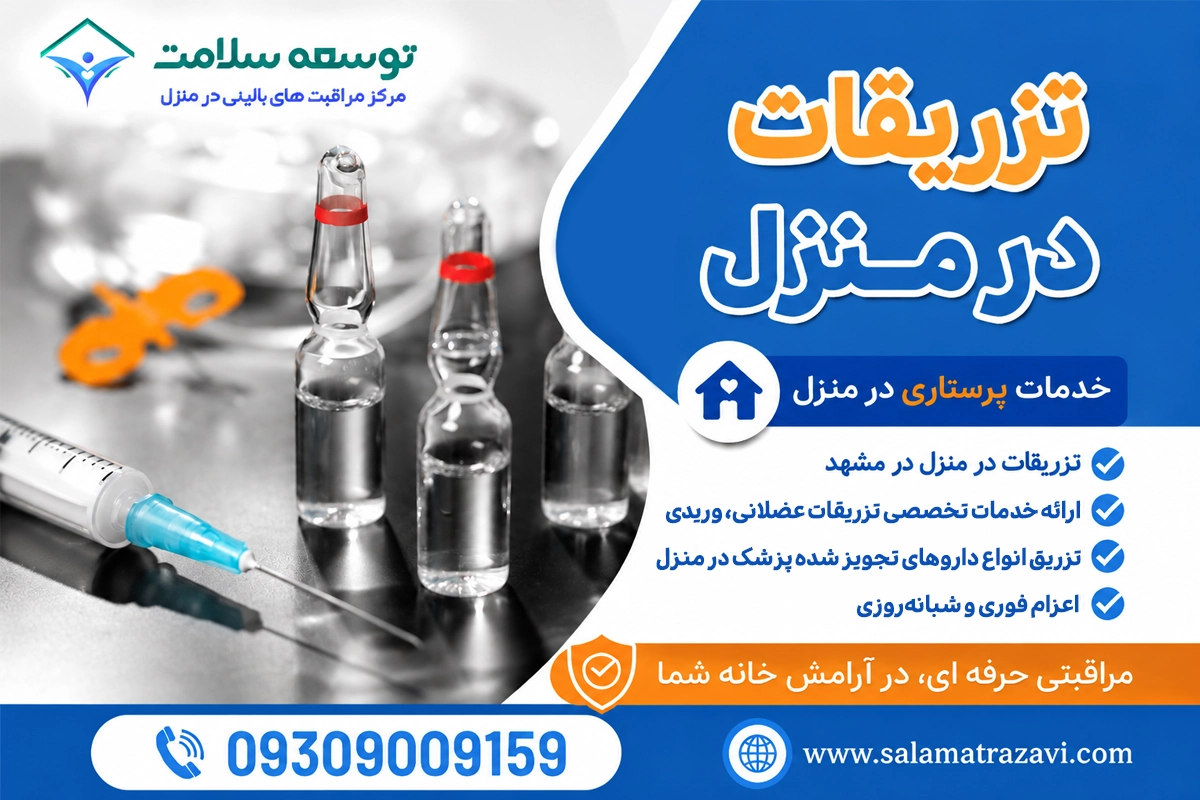
If a doctor has prescribed injections, IV therapy or other injectable treatment for you or a family member and you cannot get to a medical centre, the Tose Salamat home clinical care centre provides injections at home in Mashhad with experienced nurses and standard equipment. For more information or to book, call +98 930 900 9159.